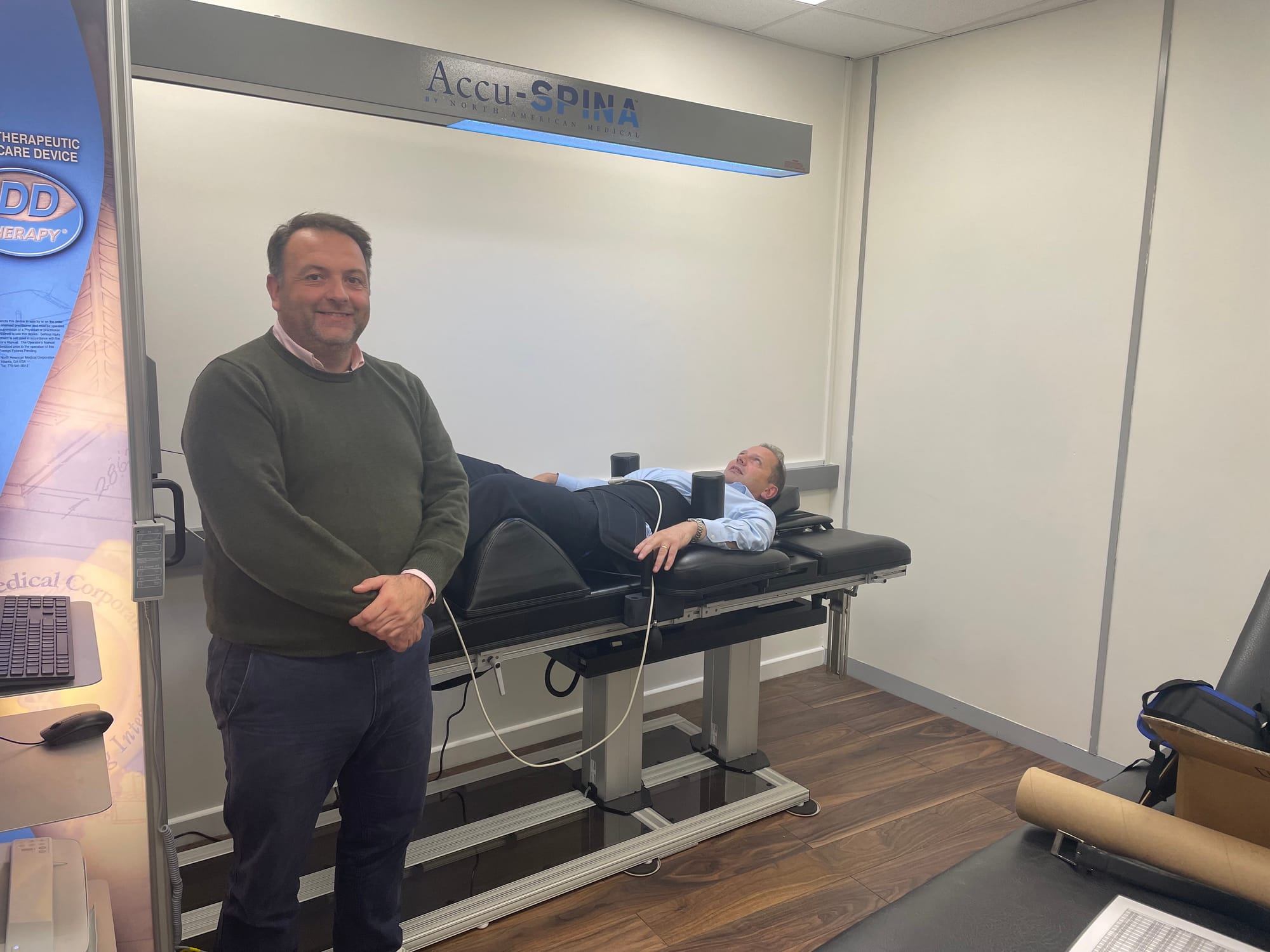
Andrew Wade explains what IDD Therapy is, how spinal decompression treatment works, who it may help and what patients can expect during treatment.
Paid advertorial
What is IDD Therapy? IDD stands for Intervertebral Differential Dynamics. It is a non-surgical spinal decompression treatment intended for people experiencing persistent back or neck pain.
How it works: Treatment uses computer-controlled forces to target specific areas of the spine, with sessions typically combined with osteopathy and home exercises.
Worth knowing: Patients require a recent MRI scan before treatment, and certain medical conditions may make IDD Therapy unsuitable.
What Is IDD Therapy?
One of the first questions I get asked by someone who is inquiring about IDD therapy is “what does IDD Therapy stand for?”
The answer is Intervertebral Differential Dynamics. It’s a bit of a mouthful and IDD Therapy is just easier to say.
So what is IDD Therapy exactly? It is a nonsurgical, spinal decompression treatment for unresolved back pain, neck pain that may (or may not) be referring or radiating pain into the arm(s) or the leg(s).
IDD Therapy was developed in the USA in the 1990’s to address some of the short comings of traditional traction therapy and the natural limitations that manual therapies and exercise based therapies experience with the more severe cases of back pain and disc herniation and prolapse.
IDD Therapy differs from traction by using computed controlled distraction and oscillatory forces, set at specific angles to decompress and mobilise targeted spinal segments. Patients undergo a programme of sessions over a six to eight week period. Each session takes around 45 to 60 minutes to complete and will be a combination of IDD Therapy, Manual therapy (Osteopathy in this case) and some exercises to do at home. Patients will remain fully clothed during the IDD therapy treatment and many find the treatment so relaxing that it is often difficult to remain awake.
Who Is IDD Therapy Suitable For?
You might be wondering if this is the therapy for you. The typical IDD therapy patient will have a chronic (long term) history of back pain from a bulging or herniated disk (with or without the referred or radiating limb pain) that has not responded to standard manual or exercise based therapies and is being managed with medication. Many IDD therapy patients will have already have had or will be considering injections or have had minor spinal surgeries such as discectomy or laminectomy.
Due to the nature of some of the conditions that IDD Therapy will be treating an up to date (less than 2 years old) MRI scan will be required before treatment can go ahead. A copy of the MRI report and if possible, access to the images is required. If you don’t have an MRI, one can be organised at a location close to you.
What Conditions Can IDD Therapy Treat?
An MRI is needed to help indicate what will be treated. Indicated conditions include
- Herniated or bulging disc
- Sciatica
- Cervical Radiculopathy
- Degenerative disc disease
- Facet joint syndrome
- Chronic (long term) low back or neck pain
Who Cannot Have IDD Therapy?
An MRI is also need to help identify conditions that are contraindicated, that is certain conditions that would exclude someone from treatment. These include
- Osteoporosis (with a T score greater than -2.5)
- Spondylolithesis of grade 2 or higher
- Unresolved fractures of the spine (less than 6 months)
- Spondylolysis (small fractures in the vertebrae)
- Previous spinal surgery less than 6 months ago
- Any spinal joint fusing either from surgical hardware or from degenerative processes.
- Pregnant or less than 6 months post partum
- Open growth plates (No one under 18 years of age)
- Suffering from metastatic cancer
- Has a congenital spinal abnormality
- Spinal instability due to genetic defects
- Severe central spinal canal stenosis
- Unstable post surgical conditions
- Abdominal Aortic Aneurysm
The Three Phases of IDD Therapy Treatment
IDD Therapy has three phases of treatment
1. Adaptation Phase
Adaptation phase. This is where the treatment starts to work on reducing any inflammation and to moderate the pain response from the injured disc and nerves. Muscles start to relax and lengthen and spasming reduces and the pressure differentials help to promote fluid exchange in and around the disc.
2. Progression Phase
Progression phase. The treatment continues as the amount of force used in each session is increased and this is where the tissues start to repair as the collagen in the discs, muscles and connective tissues begin to remodel and become more robust. Pain should be reducing nicely by now (by up to 40%) and mobility continues to improve. This is where the body’s natural healing processes really kick in.
3. Maintenance Phase
Maintenance phase. This is where the long term benefits are built. Exercise and stretching are added into daily routines and some manual therapy might be required to keep you in good order.
Find Out More About IDD Therapy
So if this sounds like the treatment that you have been looking and you like to get in touch or if you would like some additional information, then you can contact me by calling, texting or Whatsapping me on 07960507928, emailing me at info@andrewwadeosteopathy.co.uk or visiting my website at https://andrewwadeosteopathy.co.uk/treatments/idd-therapy/
I look forward to hearing from you soon.
Take care
Andrew Wade
 Why the Signal exists
Real news takes time. Thanks for taking yours.
You've just read a story that took time to get right. No clickbait, no racing to be first, no ads chasing you down the page.
I started The Staffordshire Signal because I got fed up of local news that chased clicks instead of stories. We're independent, not-for-profit, IMPRESS-regulated and owned right here, so we answer to nobody but you.
The honest bit: local news only survives if local people choose it. If we don't, it goes.
Jenna GoodwinFounder and Editor, The Staffordshire Signal
Love what we do?
Buy us an oatcake! Cheese and bacon, if you're feeling generous. Every tip goes straight into local reporting.
Buy us an oatcakeMiss a proper paper?
Staffordshire's only regional printed magazine, full of stories worth sitting down with, delivered to your door.
Get it deliveredFollow on WhatsApp
Our stories, dropped straight into your phone. No group chat chaos, we promise.
Join the channelFind something good to do this week
Markets, gigs, history talks and family days out across Staffordshire. Running an event? Add it to our guide and let the county know.
Run a Staffordshire business?
Our readers keep the Signal going, and the businesses who advertise with us help keep it free for everyone. Reach people who read to the end, across our magazine, Signal Weekly, Signal TV and website.
Explore the heart of our county Use the interactive map above to discover local landmarks, heritage sites, and community-vetted spots. Every interaction helps support The Staffordshire Signal’s mission to keep local news free and independent.

 Cat lovers invited to nominate rescues for £10,000 ProtectaPet giveaway
 Strictly Knot Dancing to Be Streamed Live as Fundraising Tops £100,000 for Dougie Mac
 David Gardner Confirmed as Staffordshire Police’s New Chief Constable
 Government Withdraws North Staffordshire Super Council Decision Following Review
 Stoke-on-Trent Care Home Placed in Special Measures After CQC Inspection