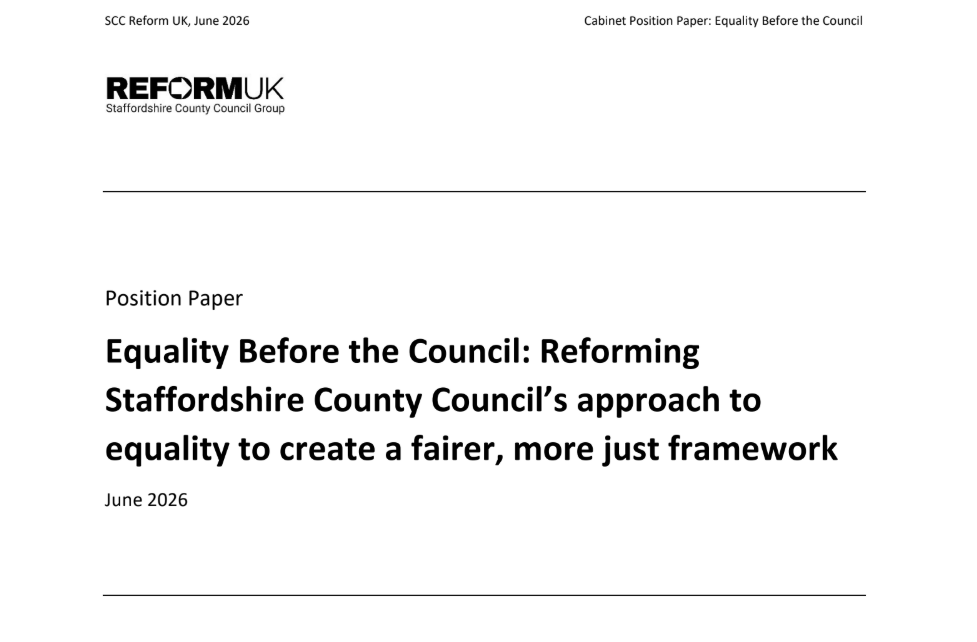
Here's what you should know about Reform UK Staffordshire's latest policy document
Politics has become a sprint. A report is leaked, headlines appear within hours, and social media decides who is right before most people have reached the second page.
That was certainly true this week. A leaked Reform UK Staffordshire policy paper generated national headlines after outlining proposals to overhaul Equality, Diversity and Inclusion (EDI) policies. Within hours, the document had become another front in Britain's increasingly polarised culture war. Depending on who you asked, it was either a long overdue return to common sense or a direct attack on equality itself.
But headlines rarely tell the whole story.
Rather than rushing to add another opinion to the pile, we've taken the time to read the document in full and assess it on its actual contents. In doing so, we set ourselves two simple questions: what does the report actually say, and what influence does it actually have? The answers are rather more nuanced than many of the headlines might suggest.
Not Council Policy, and the Document Says So
Before we begin, one fact is worth establishing from the outset. This is not Staffordshire County Council policy, nor is it a strategy written by council officers. Instead, it is a policy paper produced by the Reform UK Group on Staffordshire County Council, setting out the direction the party believes the authority should take following its election victory last year. The document's own disclaimer makes this explicit:
"This position paper does not constitute official Council policy."
That distinction is important. Political groups regularly produce policy papers setting out their ambitions. Until those proposals are tabled, debated, approved and implemented through the council's formal decision making processes, they remain exactly that: political proposals.
Reading much of the national coverage this week, however, you could easily have been forgiven for believing the report represented an immediate change in how Staffordshire County Council operates. It does not. And in most circumstances, reports such as this are kept out of the public domain in order to prevent confusion or unnecessary media frenzy.
Three Words, Thirty-Eight Pages
Another point worth making is that this report runs to a great deal more than three words, yet the phrase that attracted almost all of the attention was strikingly short. Much of the coverage described the paper as calling for the removal of "toxic EDI policies," a description drawn from the headlines rather than the document itself, which never actually uses the word "toxic." Its own language runs instead to phrases like a "legislatively faithful model" of equality.
Even so, those three words became the story. The document itself is 38 pages broader.
Across these pages, the authors argue that Equality, Diversity and Inclusion has evolved beyond ensuring compliance with the Equality Act 2010, into something far more ideological. They suggest public bodies have increasingly adopted policies that seek to produce particular social outcomes rather than simply ensuring equal treatment under the law. From that perspective, the report recommends reviewing recruitment practices, internal training, governance arrangements, communications guidance and staff policies, to ensure they align with what the authors see as the council's statutory obligations, rather than wider diversity targets.
Whether readers agree with that diagnosis is another matter. But it is important to understand that the document is making a constitutional argument about the purpose of local government, not simply proposing the removal of equality policies "for the sake of it."
Nothing New, Just Better Explained
Perhaps the most striking conclusion after reading the report is not what is new, but how much of it feels familiar. For years, Reform UK's national leadership has criticised Equality, Diversity and Inclusion initiatives across the public sector. Nigel Farage has repeatedly argued that public institutions have become distracted by identity politics, while Richard Tice has made similar arguments about meritocracy, free speech and what he describes as political neutrality. The party's 2024 General Election manifesto also contained commitments to end what it characterised as "woke ideology" throughout public services.
The Staffordshire report therefore does not represent a dramatic departure from Reform UK's existing political philosophy. Instead, it attempts something rather different: it explains how those national beliefs might be translated into the day to day workings of a county council. And that makes the document significant, not because it tells us something we did not already know about Reform UK, but because it begins to answer a different question, what does Reform governance actually look like in practice?
Who Wrote It, and What It Costs
One of the more interesting aspects of the report is that it spends surprisingly little time making overtly political attacks. Instead, much of the document is devoted to historical practice, law and political philosophy. The author, whom the paper's own disclaimer suggests is a politically restricted political assistant appointed under the Local Government and Housing Act 1989 rather than a regular officer, repeatedly refers to concepts such as equality before the law, transparency and the role of public institutions, arguing that councils should provide services impartially rather than pursuing wider social or cultural objectives.
Whether that argument is persuasive is for readers to decide. Staffordshire's own EDI costs haven't yet been published, the report itself says a full audit is still to come, but comparable figures elsewhere suggest the sums involved may be more modest than the coverage has implied. A 2025 Freedom of Information response from Devon County Council put its EDI budget at £215,000 for 2024/25, with £654,658 spent in total between 2019 and 2024, hardly the runaway cost some headlines have suggested.
But it does demonstrate that the report is attempting to build an intellectual case rather than the list of campaign slogans that we've seen previously. Indeed, many of the recommendations flow directly from that central premise. If the purpose of local government is simply to deliver statutory services fairly and efficiently, the report argues, then policies perceived as going beyond those statutory responsibilities should be reviewed. That is the thread that runs consistently throughout the document.
What the Report Deliberately Leaves Out
Interestingly, some of the most revealing aspects of the report are the things it does not propose. It does not suggest withdrawing from the Equality Act 2010, and it does not argue that councils should ignore their legal duties towards protected characteristics. In fact, the report repeatedly emphasises compliance with existing equality legislation.
The disagreement, therefore, is not about whether equality law should exist. It is about how broadly councils should interpret their responsibilities beyond those legal minimums, a significant distinction that many headlines don't seem to acknowledge. Much of the public debate has framed the issue as one of equality versus inequality. The report itself frames it rather differently: statutory equality versus what its authors see as ideological expansion. Whether that distinction is substantial will be revealed in time, but nonetheless, the argument is being made.
Why the Timing Matters
The timing of the leak is perhaps just as significant as its contents. Until recently, Reform UK could make broad national arguments without the responsibility of governing. Now, in Staffordshire, the party controls one of England's largest county councils, and that changes their operation significantly. Ideas which previously existed largely in manifestos and conference speeches are now being translated into proposals for local government.
Naturally, that attracts greater scrutiny, as it should. Government deserves to be examined more closely than opposition, and that forces political policies to conform with parliamentary legislation.
So What Does It Actually Change?
This is perhaps the most important question of all, and the answer, at least for now, is: less than many headlines implied. The document does not change council policy. It does not automatically abolish any existing strategies. It does not bind officers to act in a particular way. Any significant changes would still require decisions through the council's established democratic processes, with many requiring Cabinet approval or wider decisions by elected councillors.
That means the report should perhaps be viewed less as an instruction manual and more as a statement of political intent. It tells us where the Reform UK Group would like Staffordshire County Council to go. And that's as far as it goes.
Our Verdict
There is a temptation in modern politics to treat every document or statement as a political earthquake. Sometimes they are. Sometimes, when studied and properly understood, they tell us little more than what's already known. Having read this report in full, it feels much closer to the latter.
It undoubtedly matters. It provides the clearest insight yet into how Reform UK's councillors believe local government should operate, and it offers a detailed explanation of a political philosophy that has often been communicated nationally through hollow slogans and campaign speeches. But it does not reveal a fundamentally new direction of travel. Those familiar with Reform UK's national positions on Equality, Diversity and Inclusion, meritocracy and the role of the state will find remarkably little here that contradicts or significantly expands upon what party leaders have been saying for several years.
In that sense, the document's greatest significance may not lie in its policy recommendations at all. Instead, it marks the point at which Reform UK begins to move from opposition to administration, from explaining what it opposes to explaining how it believes government should work.
But if the document teaches us anything, it is perhaps this. Good journalism should do more than amplify the loudest headline. Sometimes the most valuable question is the simplest one.
What does it actually say?
You can download the full file here;
Enjoyed this story?
The Staffordshire Signal is a not-for-profit, community-funded publication. Every tip helps keep local journalism free, independent, and focused on the stories that matter across Staffordshire.
Every contribution supports reporting, photography, and storytelling across the county.
Join The Staffordshire Signal on WhatsApp
Never miss a single breaking update, local news story, community event, or deep dive. See everything happening in Staffordshire first, straight to your phone!
Get Instant Updates

 Cabinet Approves Community Fund and Local Plan Debate Continues
 Councillor loses seat on Kidsgrove Town Council after failing to formally accept position
 Vegan Festival Returns to Newcastle-under-Lyme This July
 Young performers invited to take over The Big Feast stage
 A day to go down in history! Tamworth care home residents visit RAF Museum