Inside the Cheddleton creamery where Staffordshire's last artisan cheesemakers are keeping an 800 year old county tradition alive, and why they would love you to join them
What's new: The Staffordshire Cheese Company in Cheddleton, the county's last artisan cheesemakers, wants more people to learn the craft and get involved.
By the numbers: Around 800 years of Staffordshire cheesemaking, and a score of 98 out of 100 at the Melton Mowbray Artisan Cheese Festival in 2025.
Why it matters: Without new people learning these traditional skills, a piece of Staffordshire's food heritage could quietly disappear.
The first thing you are handed at the Staffordshire Cheese Company is not a sample. It is a pair of overshoes. Then come the hand washing, the arm washing and a polite request to remove any jewellery, before Mary Button leads you through to a production room that smells gloriously of warm milk and is, on the day I visit, very wet underfoot. That is because Mary is making butter, and she would quite like me not to break anything, least of all myself.
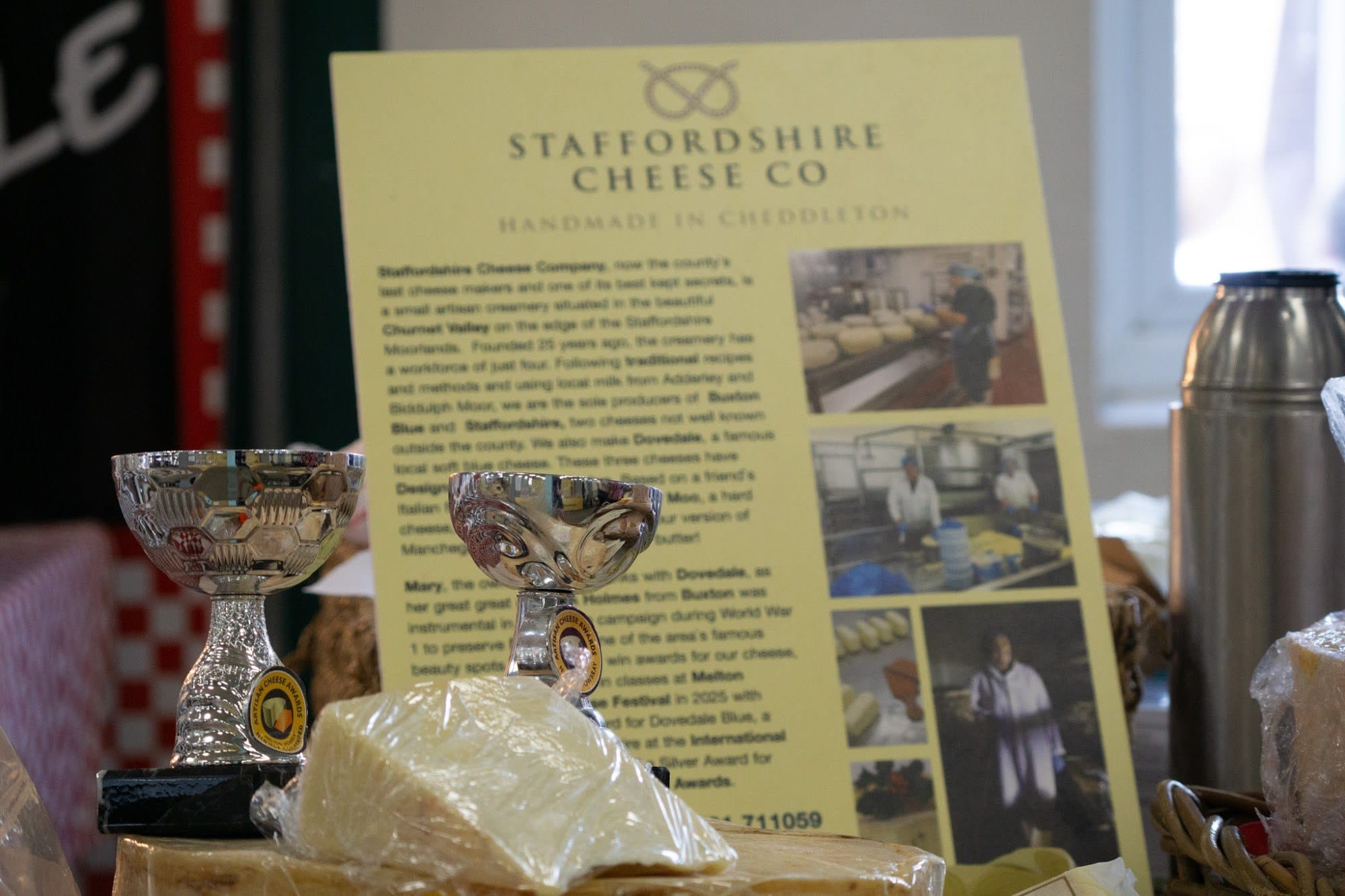
Tucked away on a small industrial estate in Cheddleton, in the Churnet Valley, this unassuming unit is home to the last artisan cheesemakers in Staffordshire. Once there were four or five cheesemakers working at scale across the county. One by one they have gone by the wayside. Mary and her small team are still here, still doing everything the traditional way, and still winning awards for it.
“We are the last artisan cheesemakers here. We do everything very traditionally.”
A cheese the monks would recognise
Staffordshire's cheesemaking story goes back a very long way. According to the official product specification held by the Government, Staffordshire Cheese was first made by the Cistercian monks who settled at Leek in the 13th century. Self-sufficiency was the order of the day, and alongside their prayers, pots and beer, the monks made cheese from the milk of cows grazing the county's lush limestone pastures.
It carried on, in one form or another, for the best part of seven centuries, until the Second World War. Wartime food policy, with milk gathered centrally by the Milk Marketing Board, saw countless regional cheeses quietly disappear, and Staffordshire's went with them.
It took until the 1990s for anyone to bring it back, with the Staffordshire Cheese Company starting life in Leek before moving to Cheddleton. In 2007 Staffordshire Cheese was awarded Protected Designation of Origin status, putting it in the same club as Stilton and Parma ham, and in 2024 Japan added it to its own list of protected British foods. Not bad for a cheese that very nearly did not survive the war.
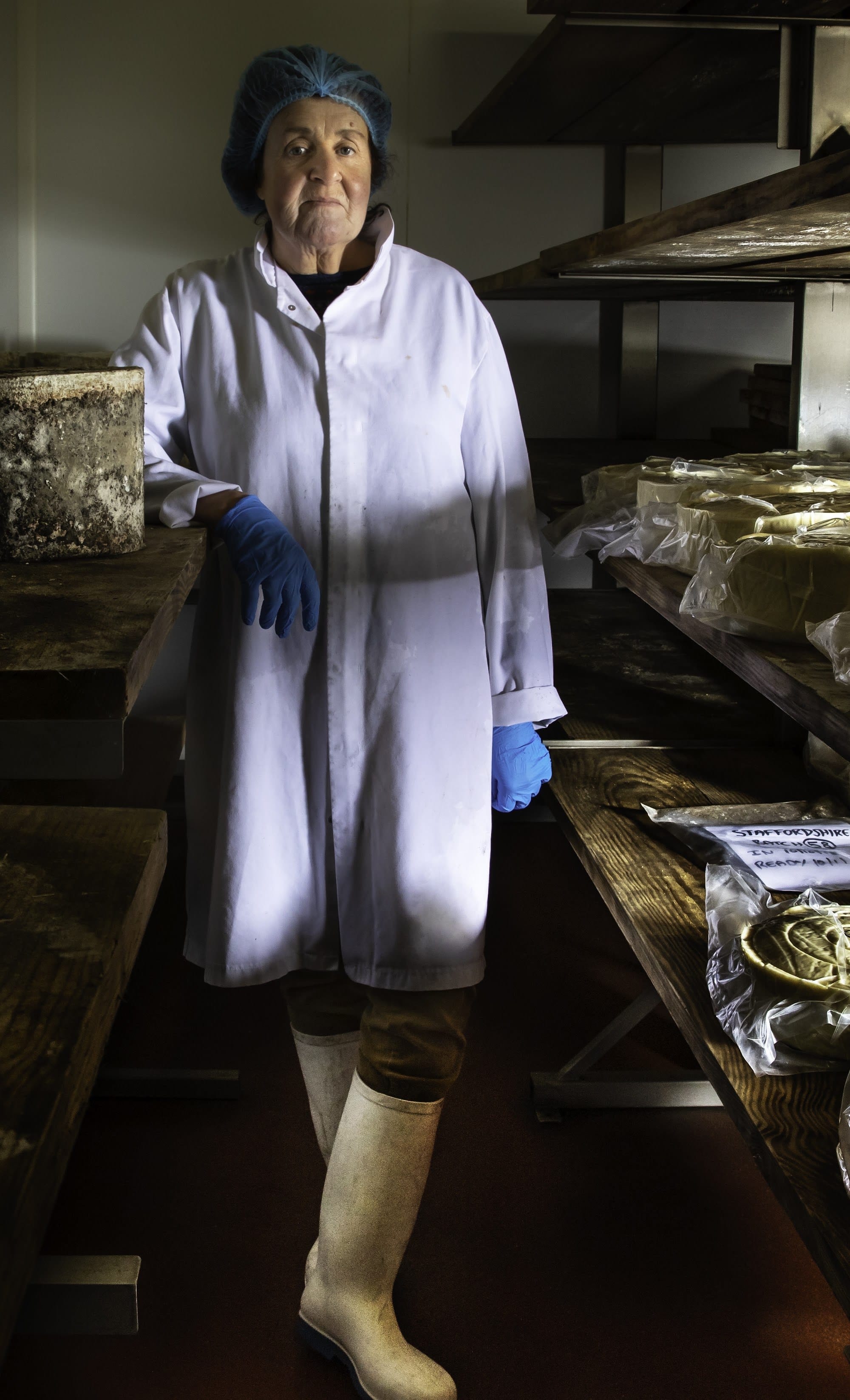
Mary from the Dairy
If you have ever bought cheese from her at a farmers' market, you will know her introduction: “I'm Mary from the Dairy.” It gets a laugh, she admits, and then she has you, talking about how it is made, where the milk comes from and why it tastes the way it does. That conversation, especially with older customers who remember when this sort of thing was far more common, is one of her favourite parts of the job.
Mary's cheese career did not start in a creamery, or even in Staffordshire. After a career in children's services, she was living in Mansfield in 2002 when the local market was struggling. She and a friend decided to take a stall to encourage people to shop locally, and when they asked themselves what to sell, the answer was cheese. Her friend eventually moved on, but Mary carried on, building up a round of farmers' markets across Nottinghamshire and Derbyshire and spending the best part of a decade selling other people's cheese.
Then, in 2017, came the offer that changed everything. The owner of the Staffordshire Cheese Company invited her to buy it. Other, bigger cheesemakers were interested too, but he chose Mary, and with her the business stayed in Cheddleton. The plan was once to move it to her partner's farm near Ashbourne, until Covid came along and changed everything. So it stayed put, and Staffordshire is all the better for it.
She had no cheesemaking experience whatsoever when she took over. The creamery came with a cheesemaker, Steve, who has since retired, and a skilled cutter and packer, Neil, who is still very much part of the team and very much in charge of the butter paddles on the day I visit. Around ten years on, Mary has steered the business firmly towards artisan territory, putting quality ahead of volume. It is a small operation, just two people full time, with two more coming in one day a week, but the results speak for themselves.
From the farm to the vat
The milk comes from a local farmer just a few miles away. Mary keeps her own small milk tanker, holding around 2,500 litres, on his farm, and he brings over the morning's milk. It is pumped through a hole in the wall straight into a refrigerated bulk tank, where it normally stays for a couple of days. The goats' milk comes from Biddulph Moor and even the salt, an essential ingredient, comes from just over the border in Cheshire. We will forgive her that one!
Everything is pasteurised. The milk is heated to 72.6 degrees and held there for 15 seconds, and every batch is recorded digitally so Mary can prove it has been done. She takes this extremely seriously. Cleanliness, she tells me, is the most important thing in cheesemaking, and because they are not her cows, pasteurisation is the safest way to be sure. She spends hundreds of pounds every month on testing too: the milk, the curd, the equipment, the cheese when it is made and the cheese again when it reaches the end of its shelf life.
From there, the milk goes up into the cheese vat, which Mary cheerfully describes as “where the magic happens”. Making cheese, it turns out, comes down to two things. First, starter cultures are added to make the milk acidify. Then rennet goes in, which separates the milk into curds and whey. The whey is the watery part, and the curds, about ten per cent of the milk, hold the butterfat, protein and minerals that become the cheese. Of the 1,100 litres they used the day before my visit, only around a tenth ends up as cheese.
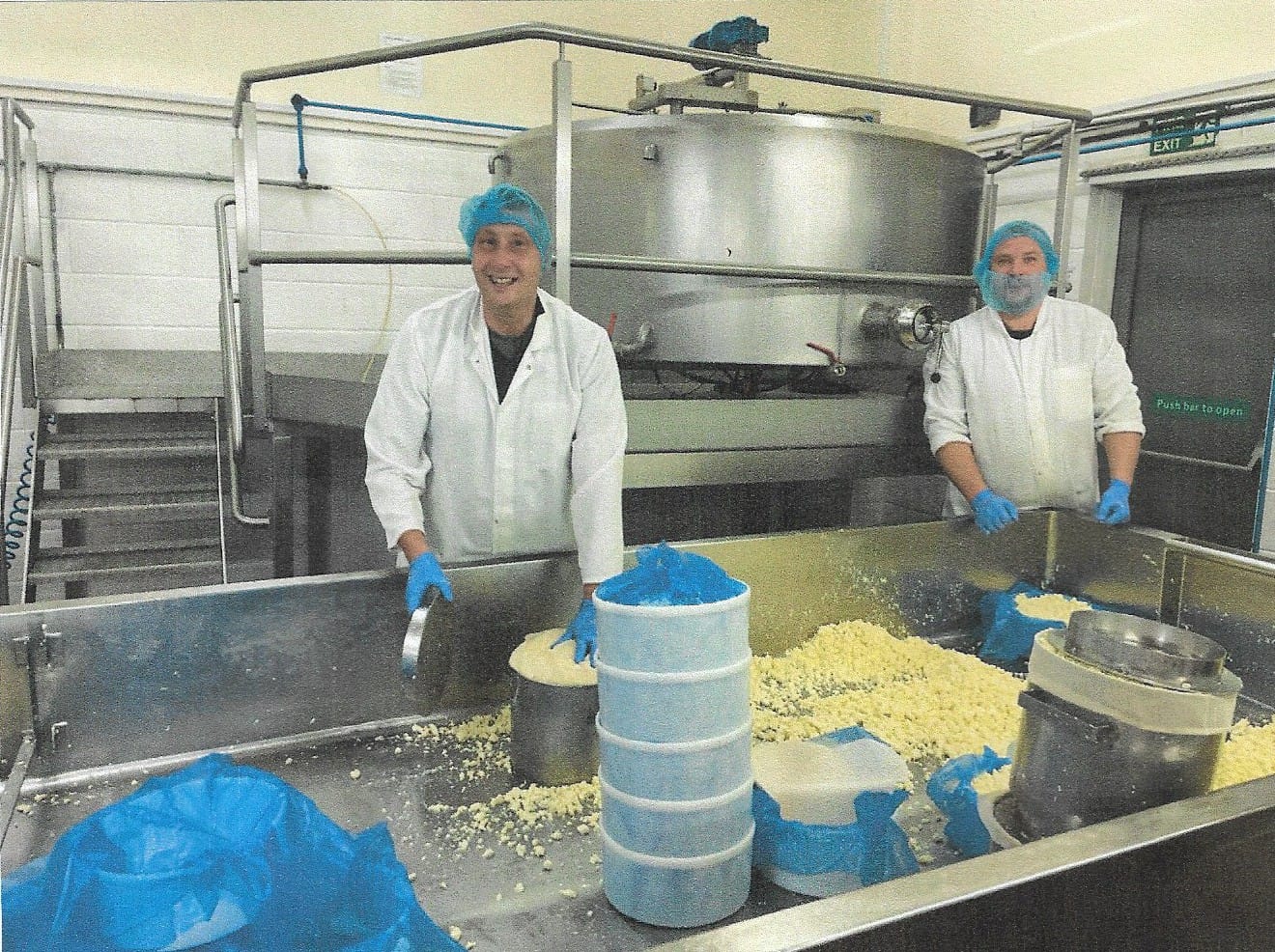
The acidity has to hit a certain level within a certain time. If it does not, something has gone wrong and the whole batch cannot be used. Beyond the readings, much of it comes down to experience: knowing by the look of the curd whether it is ready for that particular cheese. As Mary puts it, that is knowledge you build up yourself over years, not something you read in a recipe book.
What happens next depends on the cheese. For the Staffordshire, the whey is drained off, leaving big lumps of curd that are milled, salted and packed into forms to be pressed. For Dovedale, a soft blue made in a brie style, the milk is kept at a lower temperature so it holds more moisture, and the large, sloppy curds are ladled into moulds by hand. The day before I visit, they made around 56 Dovedales, which sit bobbing in a strong brine bath to salt them.
Butter, the proper way
On the morning I visit, the star of the show is butter. A lot of people call it churning, Mary tells me, but it is really more of a fluffing. Cream is beaten until it separates into buttermilk and butter, the buttermilk is drained, and the butter is washed in cold water.
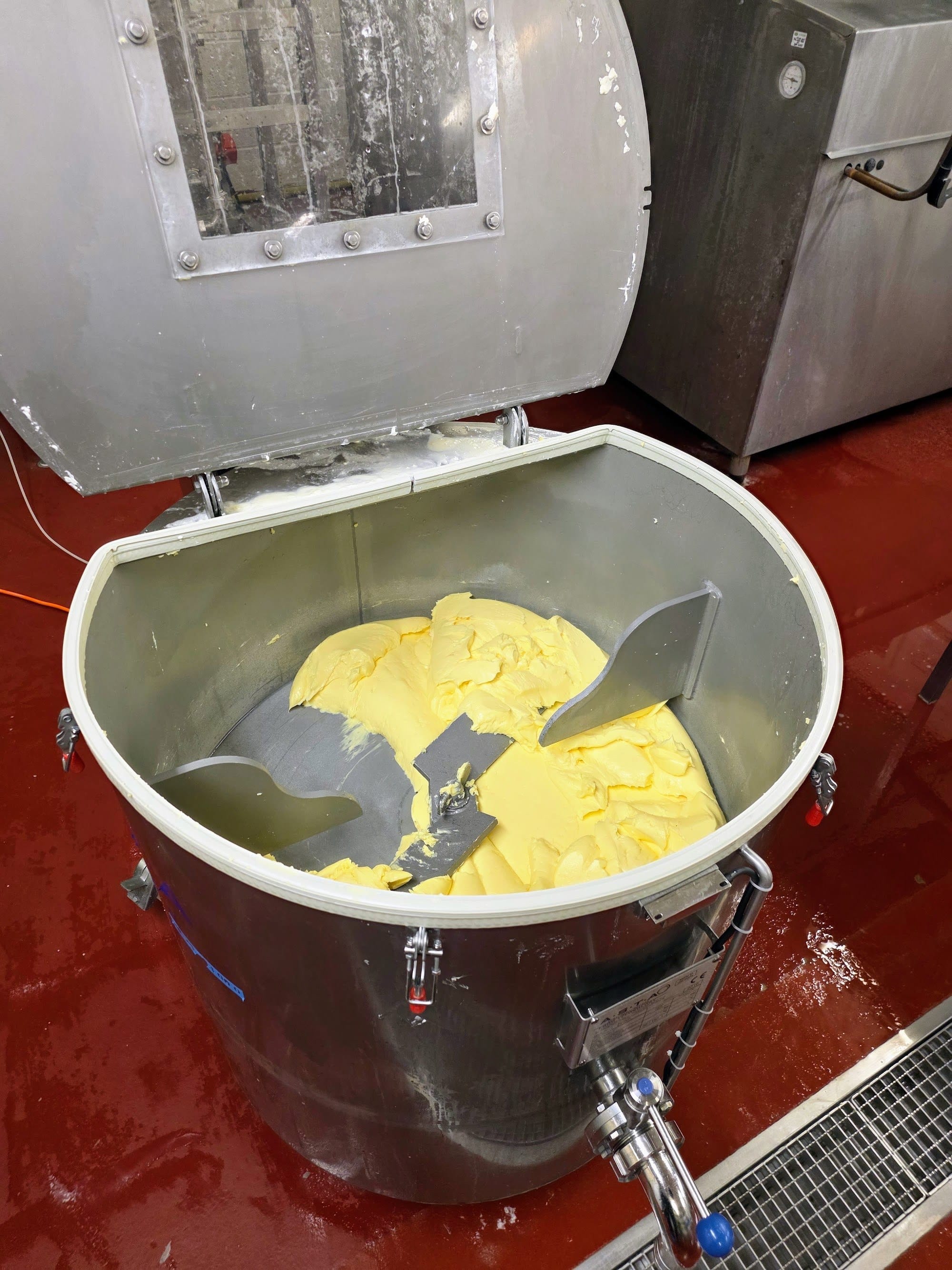
It takes around three hours from start to finish: about 45 minutes to make, half an hour to pack and then the cleaning. The result has a shelf life of three weeks, which, I can confirm from personal experience, is purely theoretical in my house.
The butter was once made mainly for the previous owner's own use, and it was Mary who opened it up so the public could buy it in small packs. In a lovely bit of local circularity, she even sells it back to the farm the cream comes from.
Award-winning, and fiercely local
The company's main cheeses are Staffordshire, Dovedale and Buxton Blue, along with a younger version of the Staffordshire called, somewhat confusingly, Cheddleton. As Mary cheerfully admits, the naming does not make life easy.
These cheeses carry protected status, which means they have to be made to strict specifications covering everything from where the milk comes from to the size of the cheese and its nutritional values. Trading Standards audit the creamery every year to make sure it all stacks up, so this is not a case of “artisan” being used loosely on a label.
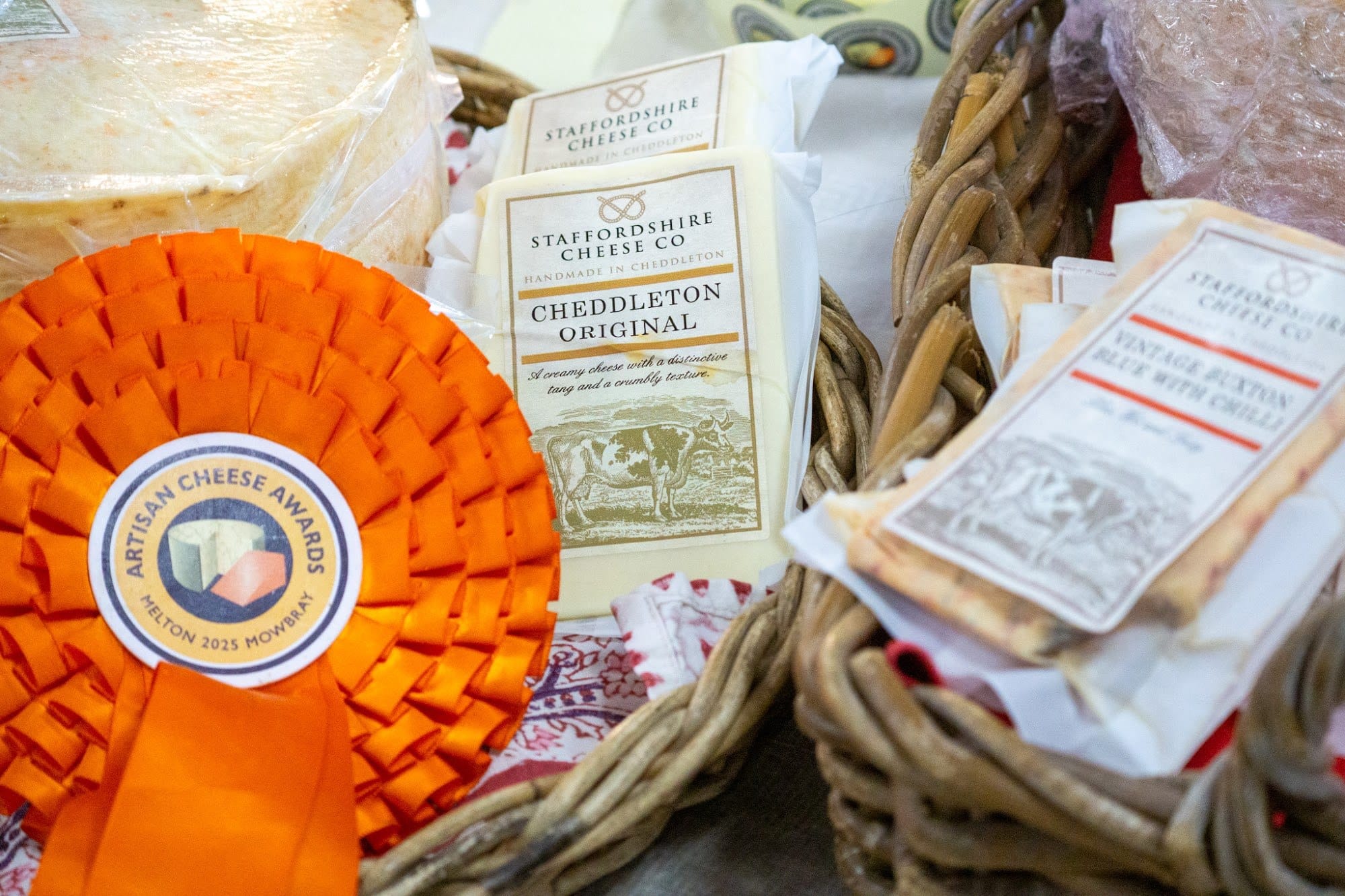
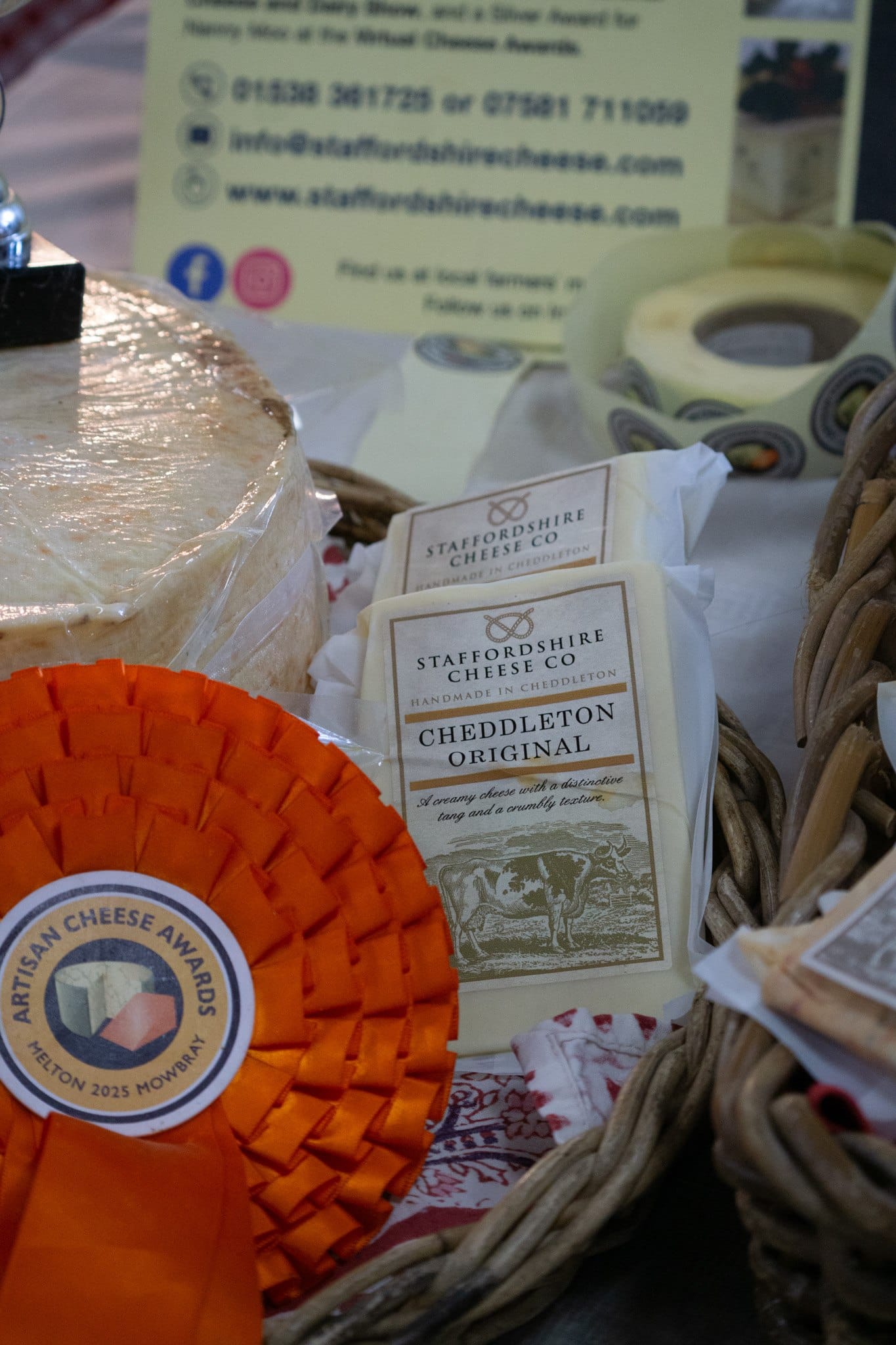
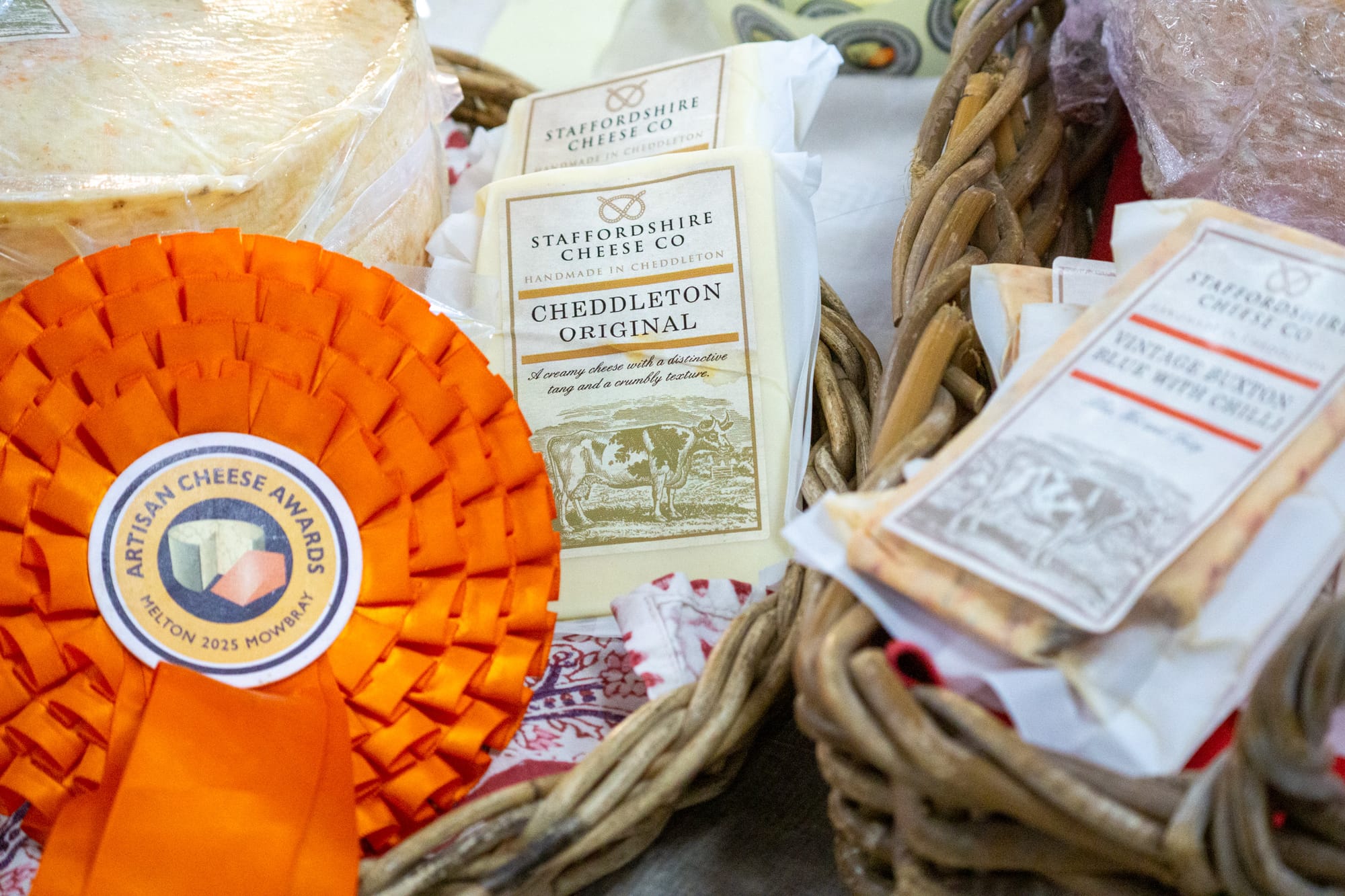
Award-winning Staffordshire cheese, rosette and all.
The Staffordshire, a traditional British hard-pressed cheese with a good bite, is the star of the competition circuit. In 2025 it scored 98 out of 100 at the Melton Mowbray Artisan Cheese Festival, which, as Mary explains, means the judges start at 100 and take marks off, and could find almost nothing to take. This year it was Highly Commended at Melton again, where Dovedale and Buxton Blue both took Silver.
The trophy cabinet does not stop there. At the Virtual Cheese Awards the Staffordshire won Silver and Bronze, and a cheese made from a mix of cows' and goats' milk took another Silver. Mary also won a blended cheese class at the International Cheese and Dairy Awards with Staffordshire Sage.
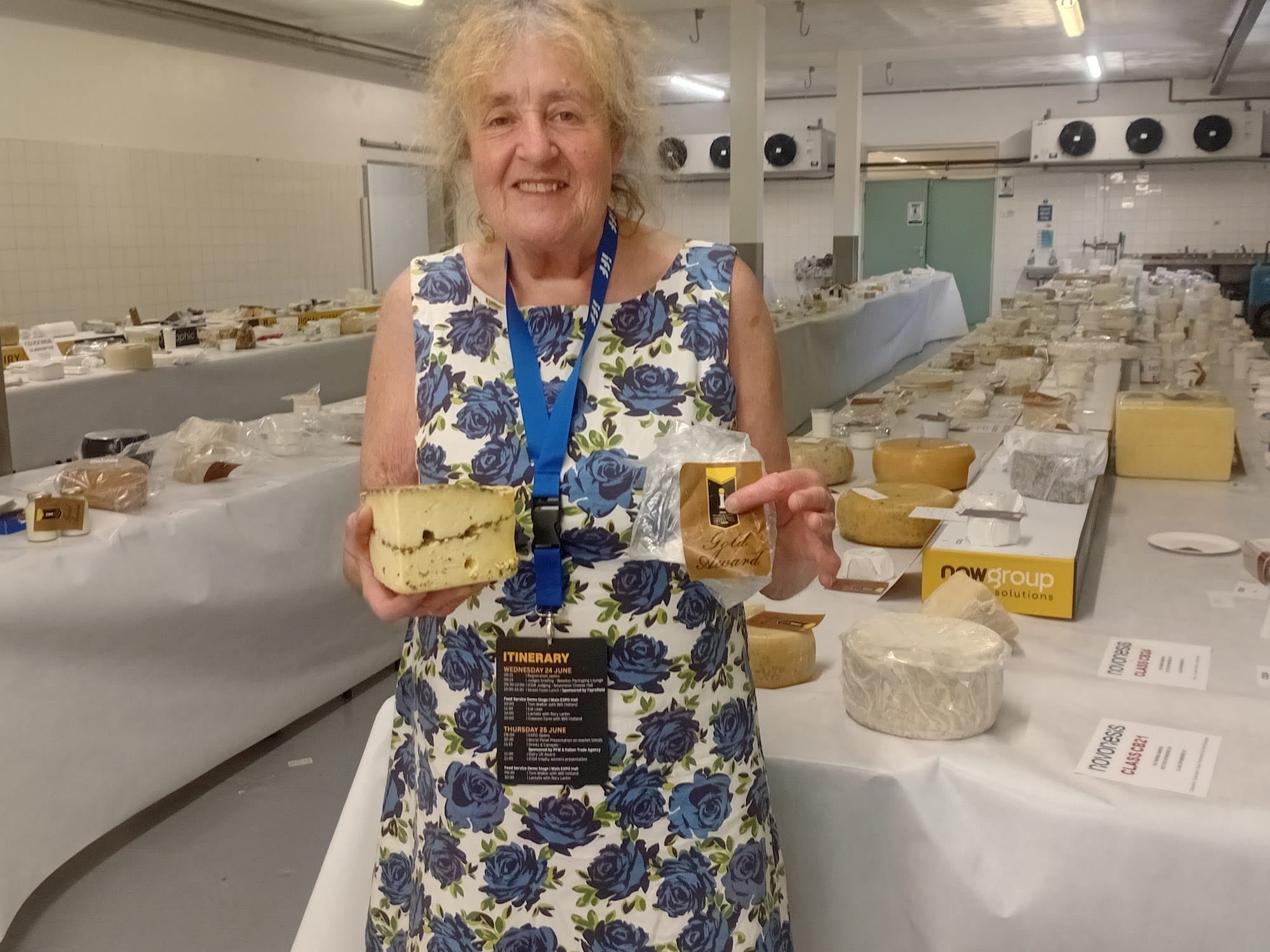
And if you are not a fan of blue cheese, Neil has a tip: try the Buxton Blue. In his experience it is the one that wins over people who swear they do not like blue.
Still experimenting
This is not a business standing still. They currently make cheese once a week, stepping up to twice a week in September and October to get ready for Christmas. In between, they are trialling new things. A small batch brie, made with around 100 litres of milk, is in the works, and some sheep's milk from Waterhouses is waiting for Mary's next new venture.
“People have an emotional relationship with food. In these times of change, what could be more comforting than a piece of local cheese?”
Why local matters
Whether your cheese comes from Cheddleton or a supermarket chiller, the basic process is the same. What is different is everything around it. You can drive past the fields the milk came from. You know who made it, how carefully it was tested and that it has not been round the country, let alone the world, before it reaches your plate. And you know your money is staying in Staffordshire.
Mary has noticed a real appetite for that. People want to reconnect with the countryside and with where their food comes from, which is exactly why so many farms are diversifying into ice cream, butter and farm shops, and why she applauds every one of them.
You will not find Staffordshire Cheese Company products online, at least not yet. Running an online shop would mean extra infrastructure, extra work and probably extra staff, so for now Mary would rather spend her time making cheese. There is a hidden benefit, too. If you have to go to a farm shop, deli or market to buy her cheese, you will probably pick up some local bread while you are there, and maybe a jar of chutney. One small producer ends up supporting several more.
Fancy getting involved?
This is where you come in. With the business doing well and the awards still coming, Mary wants to see more people involved in artisan cheesemaking in Staffordshire, so the county's skills keep growing rather than quietly disappearing.
She would love to hear from anyone who would like to come and see what they do and work alongside her, whether that is on a voluntary basis, as a genuine interest in learning the craft, or as something bigger. It could be a perfect fit for a farm that is already diversifying, perhaps into cured meats or a farm shop, and wants to explore cheese alongside it. It is a rare chance to learn a traditional skill from people who do it every week.
If that sounds like you, get in touch with the Staffordshire Cheese Company at info@staffordshirecheese.com, or drop us a line at The Staffordshire Signal and we will happily point you in the right direction.
And if cheesemaking is not quite your calling, you can still do your bit. Look out for Mary at local farmers' markets, ask for Staffordshire Cheese by name at your farm shop, deli or local pub, and put a wedge of it on the Christmas cheeseboard instead of something that has travelled halfway round the world.
Where to buy
- Farmers' markets: find Mary at Stone, Belper, Beeston, Derby and Bakewell farmers' markets.
- Pronto, Leek: the deli on Sheepmarket.
- Farm shops and dairies: Rock End Farm, Knypersley; Oakleys Farm, Cheadle; Creamhouse Dairy, Checkley; Denstone Farm Shop; Canalside, Great Haywood; Croots Farm Shop, Duffield.
- Cheddar Gorge, Ashbourne: just over the border in Derbyshire.
- Hotels: also on the cheeseboard at a number of local hotels.
- Little Bean, Stafford: down the little alleyway opposite the police station.
- Specialist cheesemongers: also sold through a top-end cheesemonger at markets across the Midlands.
The Staffordshire cheeseboard
- Staffordshire: traditional hard-pressed farmhouse cheese with a good bite. The award winner.
- Cheddleton: the younger, milder version of the Staffordshire. Confusing name, excellent cheese.
- Dovedale: a soft blue, made in a brie style.
- Buxton Blue: Neil's recommendation for people who think they do not like blue.
- Butter: made in small batches in Cheddleton. Three week shelf life, in theory.
The Staffordshire Cheese Company, Harrison Way, Cheddleton, ST13 7EF. Email info@staffordshirecheese.com.
You can follow The Staffordshire Cheese Company on social media.
Photos: Jenna Goodwin / The Staffordshire Signal, and courtesy of Mary Button / Staffordshire Cheese Company.
 Why the Signal exists
Real news takes time. Thanks for taking yours.
You've just read a story that took time to get right. No clickbait, no racing to be first, no ads chasing you down the page.
I started The Staffordshire Signal because I got fed up of local news that chased clicks instead of stories. We're independent, not-for-profit, IMPRESS-regulated and owned right here, so we answer to nobody but you.
The honest bit: local news only survives if local people choose it. If we don't, it goes.
Jenna GoodwinFounder and Editor, The Staffordshire Signal
Love what we do?
Buy us an oatcake! Cheese and bacon, if you're feeling generous. Every tip goes straight into local reporting.
Buy us an oatcakeMiss a proper paper?
Staffordshire's only regional printed magazine, full of stories worth sitting down with, delivered to your door.
Get it deliveredFollow on WhatsApp
Our stories, dropped straight into your phone. No group chat chaos, we promise.
Join the channelFind something good to do this week
Markets, gigs, history talks and family days out across Staffordshire. Running an event? Add it to our guide and let the county know.
Run a Staffordshire business?
Our readers keep the Signal going, and the businesses who advertise with us help keep it free for everyone. Reach people who read to the end, across our magazine, Signal Weekly, Signal TV and website.
Explore the heart of our county Use the interactive map above to discover local landmarks, heritage sites, and community-vetted spots. Every interaction helps support The Staffordshire Signal’s mission to keep local news free and independent.
 Seconds That Save Lives
 New Funding Boost for Young People in Stoke-on-Trent
 Free Arthur Berry Outdoor Art Exhibition Opens in Burslem Town Centre
 Trentham Shopping Village Celebrates Christmas with Festive Street Party
 Dougie Mac Invites Staffordshire Residents to Remember Loved Ones This Christmas