Staffordshire's Local Government Reorganisation is confirmed: all ten councils, including Newcastle-under-Lyme, will be abolished and replaced by two new unitary authorities, North Staffordshire and South Staffordshire, by 2028. Here's what it means for residents, businesses and services.
Ten councils. Gone. Replaced by two. If that sentence alone has left you with questions, you are in good company. This week's confirmation that the government is abolishing every council in Staffordshire and Stoke-on-Trent, and replacing them with two brand new authorities, is one of the biggest shake-ups to hit local government here in over fifty years. So let's slow down, take it apart piece by piece, and look at what it means, who is furious about it, and why some people think it is genuinely a good thing.
First, the plain English version
Right now, most of us in Staffordshire are governed by two councils at once, even if we rarely think about it that way.
If you live in Newcastle-under-Lyme, Stafford, Cannock Chase, Lichfield, Tamworth, East Staffordshire or the Moorlands, one council, your borough or district council, empties your bins, decides your planning applications, runs your parks and looks after housing. A second council, Staffordshire County Council, handles the bigger, more expensive stuff: social care, education, roads and libraries. If you live in Stoke-on-Trent, you already have just the one council doing everything, because the city has been a "unitary" authority since 1997.
The government wants everyone in a "unitary" system now, one council, one place, doing everything. Their argument is that having two councils per area is confusing, wasteful and slower than it needs to be. So, over the past eighteen months, every council in Staffordshire has been asked to come up with proposals for how the county could be carved up into one or more single-tier super-councils.
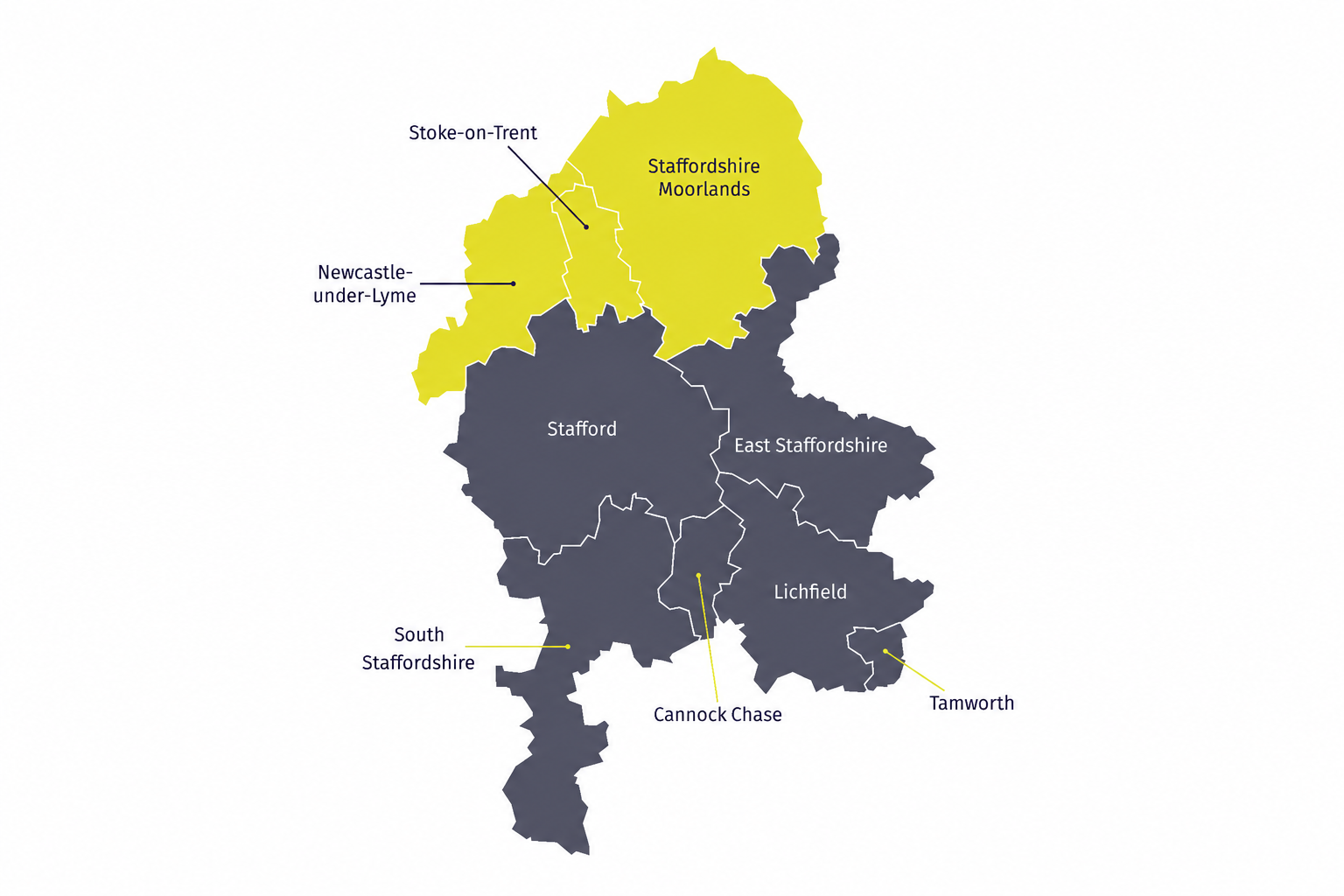
This week, ministers finally picked a winner. From 2028, Staffordshire and Stoke-on-Trent will be run by just two councils:
- North Staffordshire: Newcastle-under-Lyme, Stoke-on-Trent and Staffordshire Moorlands
- South Staffordshire: Cannock Chase, East Staffordshire, Lichfield, South Staffordshire, Stafford and Tamworth
That is it. Staffordshire County Council disappears. All eight district and borough councils disappear. Stoke-on-Trent City Council, as a standalone authority, disappears too, folded into the new North Staffordshire body. In their place, two new councils will run everything, bins to bus routes, planning to potholes, for the whole county.
Why now, and why this shape
This did not happen overnight. Back in February 2025, the government wrote to every council in Staffordshire and Stoke-on-Trent formally inviting them to submit proposals. Five rival visions came back by the November 2025 deadline:
- A north and south split, backed by Stoke-on-Trent, Stafford, Cannock Chase and East Staffordshire, this is the model that has now won.
- An "Enhanced" North Staffordshire, put forward by Staffordshire Moorlands, which would have added Stone, Uttoxeter and the surrounding villages into the northern authority.
- A three-council model, favoured by Lichfield, Tamworth and South Staffordshire, which would have split the south of the county in two.
- An east-west split, championed by Staffordshire County Council itself, dividing the county down the middle rather than top to bottom.
- A bid from Newcastle-under-Lyme Borough Council to go it alone, remaining a standalone unitary authority on its existing boundary.
Between February and March 2026, the government ran a seven week public consultation asking residents what they thought of the options on the table. Ministers then spent several months weighing that feedback, alongside financial analysis and their own criteria (chiefly that a new council should serve somewhere in the region of 500,000 people and make sense as an economic area), before confirming their decision on Thursday 16 July 2026, just hours before MPs broke up for the summer.
The backlash: councillors from every corner of the county have objections
If you have been anywhere near a council meeting in Staffordshire over the past year, you will know this has never been a quiet, technical process. It has been a genuine political fight, and this week's announcement has reignited it.
The loudest voice by far belongs to Jonathan Gullis, the Reform UK leader of Newcastle-under-Lyme Borough Council and former Stoke-on-Trent North MP. Newcastle has objected to this merger from the very start, and Cllr Gullis did not soften his language when the decision landed. He called it:
"A shameful betrayal of Newcastle-under-Lyme and the people who call our borough home. Ministers have ignored more than 11,000 residents who signed the petition. They have ignored the clear cross-party position of the Borough Council. They have ignored local people who overwhelmingly said that, if reorganisation was forced upon us, Newcastle-under-Lyme must remain independent."
This is not a new complaint from Cllr Gullis. Back in May, in a letter to the Secretary of State, he argued the whole process should be scrapped altogether, describing it as something the current instability in national government could not deliver properly, and warning it risked wasting taxpayers' money on a plan that might never see the light of day. His deeper objection, repeated again this week, is that Newcastle is being asked to give up its council with no clear promise of what it gets in return. As he put it:
"Forcing through the abolition of our councils without delivering meaningful regional devolution would be the worst of all worlds. The government is taking local power away from Newcastle-under-Lyme while failing to give Staffordshire and Stoke-on-Trent the strategic powers and investment already enjoyed by neighbouring regions."
Newcastle is not the only borough that feels hard done by. Lichfield, Tamworth and South Staffordshire had jointly proposed a three-way split of the south of the county, arguing that a single southern authority covering six former districts would simply be too big and too remote to feel local. That model was not chosen.
And it is not only district and borough councillors who have been unhappy. Staffordshire County Council, whose own east-west proposal also lost out, saw councillors from every party unite against the whole idea of reorganisation last autumn. In a cross-party letter, former Cllr Ian Cooper, who was council leader at the time but has since stood down from that role, and colleagues wrote:
"Let us be absolutely clear: Staffordshire did not ask for LGR, does not want LGR, and does not need LGR."
The letter warned that creating entirely new governance structures risked diverting money and staff time away from frontline services such as social care, that the government's own timetable was "unrealistic", and that residents were worried about losing local accountability altogether. There was also a specific financial fear raised repeatedly by county councillors: that whichever new northern authority absorbed Stoke-on-Trent would inherit the city's well-documented financial difficulties, and that ratepayers elsewhere would end up picking up the bill. Conservative opposition leader on the county council, Philip White, put it bluntly:
"I am yet to speak to anyone who believes Stoke-on-Trent has any connection to areas like Tamworth and Lichfield, and the East will inevitably have to pay more tax to prop up the debt of Stoke-on-Trent."
Join The Staffordshire Signal on WhatsApp
Never miss a single breaking update, local news story, community event, or deep dive. See everything happening in Staffordshire first, straight to your phone!
Get Instant UpdatesIt is not just a Newcastle and county council story either. In the south of the county, Lichfield District Council leader Cllr Doug Pullen had been fighting for months for a different outcome altogether, three smaller unitary councils rather than two large ones, and days before the announcement he set out exactly why, drawing on his own experience of being held to account over a delayed cinema project in Lichfield city centre:
"For many months last year I was pushing, lobbying, arguing with almost every MP and council leader across southern Staffordshire for one outcome, three smaller unitary councils, not two giant ones. I'm grateful to Dave Robertson MP, who backed this early on, before it was the popular or 'guided' position to hold, and one that went against his Government's guidance.
"Right now, as Leader of Lichfield District Council, I'm under real pressure over the delayed cinema project. Questions in public meetings, scrutiny in the press, calls for resignation, people stopping me in the street to ask what is going on. It is genuinely uncomfortable, and not a pleasant place to be in, but that is democracy actually working. You know exactly who to question and hold to account. Try doing that with a distant county authority covering a million people.
"Small, local, visible councils mean leaders you can actually reach. That is worth fighting for, whatever shape reorganisation takes."
Cllr Pullen's underlying point, that a resident in Lichfield or Tamworth might struggle to even name who runs a South Staffordshire unitary covering roughly 600,000 people, let alone catch them in the street, is one shared quietly by councillors across several of the losing bids, even where they have not used language as sharp as Cllr Gullis's.
Enjoyed this story?
The Staffordshire Signal is a not-for-profit, community-funded publication. Every tip helps keep local journalism free, independent, and focused on the stories that matter across Staffordshire.
Every contribution supports reporting, photography, and storytelling across the county.
The anger has not stayed confined to town halls, either. The decision was formally announced by the Secretary of State for Housing, Communities and Local Government, Steve Reed MP, in a statement to the House of Commons on 16 July, and Newcastle-under-Lyme's own MP, Adam Jogee, used his response to the Secretary of State to reject it outright:
"The announcement today and the proposals in it are completely unacceptable, and I reject them. I reject them in the strongest terms. There is nothing here that reflects the views I have consistently put to ministers, nor any acknowledgement of the concerns received by thousands of local people in Newcastle-under-Lyme.
"Can I ask the Minister how we protect, or how he thinks we can protect, the people of Newcastle-under-Lyme from the debt held by Staffordshire County Council, Staffordshire Moorlands, and Stoke-on-Trent City Council? And why he thinks any of my constituents should have any faith in these proposals that they don't want?
"It is utterly unacceptable and a disgrace that this statement has been put to the House on the final day of term, four days before a new Prime Minister takes office. It is not too late to stop and think again."
Two things stand out there. First, an MP and a Reform council leader from the same borough, politically about as far apart as it gets, arriving at exactly the same objection is a fairly strong signal that this is a genuinely cross-party local concern rather than a party-political line. Second, Mr Jogee's timing complaint is worth taking seriously on its own merits: this is a major, generation-defining decision for the county, announced on the last sitting day before summer recess and days before a change of Prime Minister, which leaves very little immediate opportunity for MPs to press ministers further on it before the autumn.
Underneath all of this sits a broader, national row that has been rumbling through Parliament for months. MPs from Staffordshire and beyond have repeatedly pressed ministers on whether the promised savings from reorganisation actually stack up, and whether reshaping council boundaries is really the same thing as devolving genuine power. In Essex, a leaked letter revealed that ministers had gone against their own officials' advice when choosing a reorganisation model, prompting accusations that decisions across the country, Staffordshire included, are being driven more by political convenience than hard evidence. The District Councils' Network has gone further still, arguing the government has never actually commissioned independent research to justify its preference for very large "mega councils" in the first place.
In short: the fight in Staffordshire was never really about whether a north-south model made sense in principle, most councils accepted that logic early on, it has been about where exactly the lines fall, how big is too big, and whether anyone bothered to properly listen to the areas that lost out.
So what happens next, and when
Whatever anyone thinks of the decision, it is happening. Here is the timetable, as things stand:
- Later in 2026: A Structural Changes Order will be laid before Parliament. This is the legal document that nails down the detail, how many councillors each new authority will have, where the new ward boundaries sit, and how the transition will actually work in practice.
- May 2027: Elections take place for "shadow" authorities, essentially dry runs of the new North and South Staffordshire councils, operating in parallel with the outgoing councils for a year while everything is prepared behind the scenes.
- 1 April 2028, known in council circles as "vesting day": the ten existing councils, Staffordshire County Council, Stoke-on-Trent City Council and all eight district and borough councils, are formally abolished. North Staffordshire and South Staffordshire take over every single local government service in the county from that date.
Crucially, nothing changes for residents right now. Newcastle-under-Lyme Borough Council, and every other council in the county, has confirmed that bin collections, planning decisions, housing services, parks and environmental health will all continue exactly as normal while the transition is planned. There is a legal duty on every existing council to cooperate with the process, whatever their political objections to it, right through to vesting day.
Now for the case in favour
It would be a disservice to pretend this is a story with only one side. However loud the objections, there is a genuine, evidenced argument for why this change might end up being good for Staffordshire, and it is worth setting out properly.
The money. The government's central claim is straightforward: running two councils to cover one area costs more than running one. Duplicated chief executives, duplicated finance teams, duplicated back-office systems, duplicated buildings. Nationally, analysis commissioned as part of the wider devolution programme has put potential savings from reorganisation at hundreds of millions of pounds a year across England, money ministers argue can be redirected straight into frontline services like adult social care and children's services, rather than propping up administrative overlap. The government has also put real money behind the transition itself, £63 million in national capacity funding for councils going through reorganisation, on top of £7.6 million already provided to help develop proposals, specifically so councils are not left to fund the change entirely from their own reserves.
Clarity. Right now, if something goes wrong with your bins, you call the borough council. If it is a pothole outside your house, that might be the county council. If it is both a housing issue and a road safety issue, good luck working out who owns it. A single council doing everything means, in theory at least, one phone number, one website, one set of councillors accountable for the whole picture. As one minister put it during a Commons debate on the wider reorganisation programme, taking out duplicate layers of senior management "helps to push money back to the front line, where it is needed to deal with much-needed services such as filling in potholes, looking after vulnerable adults and children."
A stronger voice for the whole area. It is not only Stoke-on-Trent making this case. Staffordshire Moorlands, whose own "Enhanced North Staffordshire" bid was not the version chosen, nonetheless came out in support of the decision on the same day. Council leader Mike Gledhill was careful to frame it as a fresh start rather than an annexation by Stoke:
"The new North Staffordshire council is absolutely not a merger with Stoke-on-Trent. It's a new start for the three councils and makes sense geographically, economically and culturally.
"For the Moorlands it brings the opportunity for improved transport connectivity, greater job opportunities especially for our young people, and sensible building where it is needed using brownfield sites where possible."
Cllr Gledhill also addressed the Stoke debt worry raised by Cllr White and others head-on, rather than dodging it:
"Although a North Staffordshire Council will create opportunities, we do recognise there will be challenges too. One of these is Stoke-on-Trent's financial position. However, the Government's Fair Funding for Local Government proposals means the current city council area is likely to benefit from millions of pounds more funding in the coming years."
Stoke-on-Trent City Council put out its own news release within hours of the announcement, and Leader Jane Ashworth did not hold back in welcoming it:
"We warmly welcome the government's decision to back the North-South proposal. It is the option that most closely reflects the reality of how people live, work and travel across our area and provides the strongest basis for future success.
"The North-South model works with the grain of our communities rather than against them. It keeps North Staffordshire together as a single economic area, aligns with the way key public services already operate and creates a council that is large enough to be resilient while remaining rooted in the communities it serves.
"Most importantly, this decision gives us the opportunity to unlock growth, attract investment, accelerate regeneration and create more opportunities for local people."
The city council's release also makes a point worth pausing on: eight out of the ten existing councils across Stoke-on-Trent and Staffordshire backed some form of north-south split, even if they disagreed on exactly where the lines should fall. The genuinely hard opposition, to the principle of a north-south model itself rather than just its shape, came mainly from Newcastle-under-Lyme and Staffordshire County Council. That is a meaningfully different picture to "nobody wanted this", even allowing for the very real anger detailed above.
The door to devolution. This is, arguably, the biggest prize on the table, and even critics like Cllr Gullis agree it matters. Reorganisation is only half of the government's plan. The other half is devolution: handing new unitary councils genuine powers over transport, skills and investment, the kind Greater Manchester and the West Midlands already have through their elected mayors. All ten of Staffordshire and Stoke-on-Trent's councils jointly applied for Foundation Strategic Authority status back in March 2026, seen widely as the first formal step towards a Staffordshire and Stoke-on-Trent mayor. If that follows through, the argument goes, the short-term pain of reorganisation could be repaid many times over in long-term investment, better bus services, more control over adult skills funding, and a genuinely louder voice for this part of the Midlands in Westminster. Right now that promise remains just that, a promise, and the frustration from council leaders that no timeline has been confirmed for it is entirely understandable. But it is the reason this is being pursued as a package deal, rather than reorganisation for its own sake.
Where the Signal stands
We are not in the business of telling you which side of this to take. What we can tell you is that this is not finished, not by a long way. The next eighteen months will bring a Structural Changes Order setting out exactly how many councillors your area gets and where the new boundaries fall, a set of shadow elections in May 2027 that will decide who actually runs these new councils from day one, and, if it materialises, a decision on devolved powers and a possible elected mayor for the whole of Staffordshire and Stoke-on-Trent.
We will be covering every stage of it, in plain English, from every corner of the county, not just our own patch. If you have strong feelings on this, for or against, or questions you want put to your local council leader, get in touch. This is exactly the sort of story local journalism exists for.
Enjoyed this story?
The Staffordshire Signal is a not-for-profit, community-funded publication. Every tip helps keep local journalism free, independent, and focused on the stories that matter across Staffordshire.
Every contribution supports reporting, photography, and storytelling across the county.
Join The Staffordshire Signal on WhatsApp
Never miss a single breaking update, local news story, community event, or deep dive. See everything happening in Staffordshire first, straight to your phone!
Get Instant Updates

 Screen Staffordshire Marks First Year with £1.3 Million Boost to Local Economy
 Three more schools in Newcastle-under-Lyme to provide free breakfast clubs for pupils
 Newcastle Jazz & Blues Festival Returns for 19th Year Across August Bank Holiday Weekend
 Introducing Heather Jordan, your UK's National Miss 2026/27!
 Trentham Makers Market Returns This Saturday for a Spectacular Family Day Out