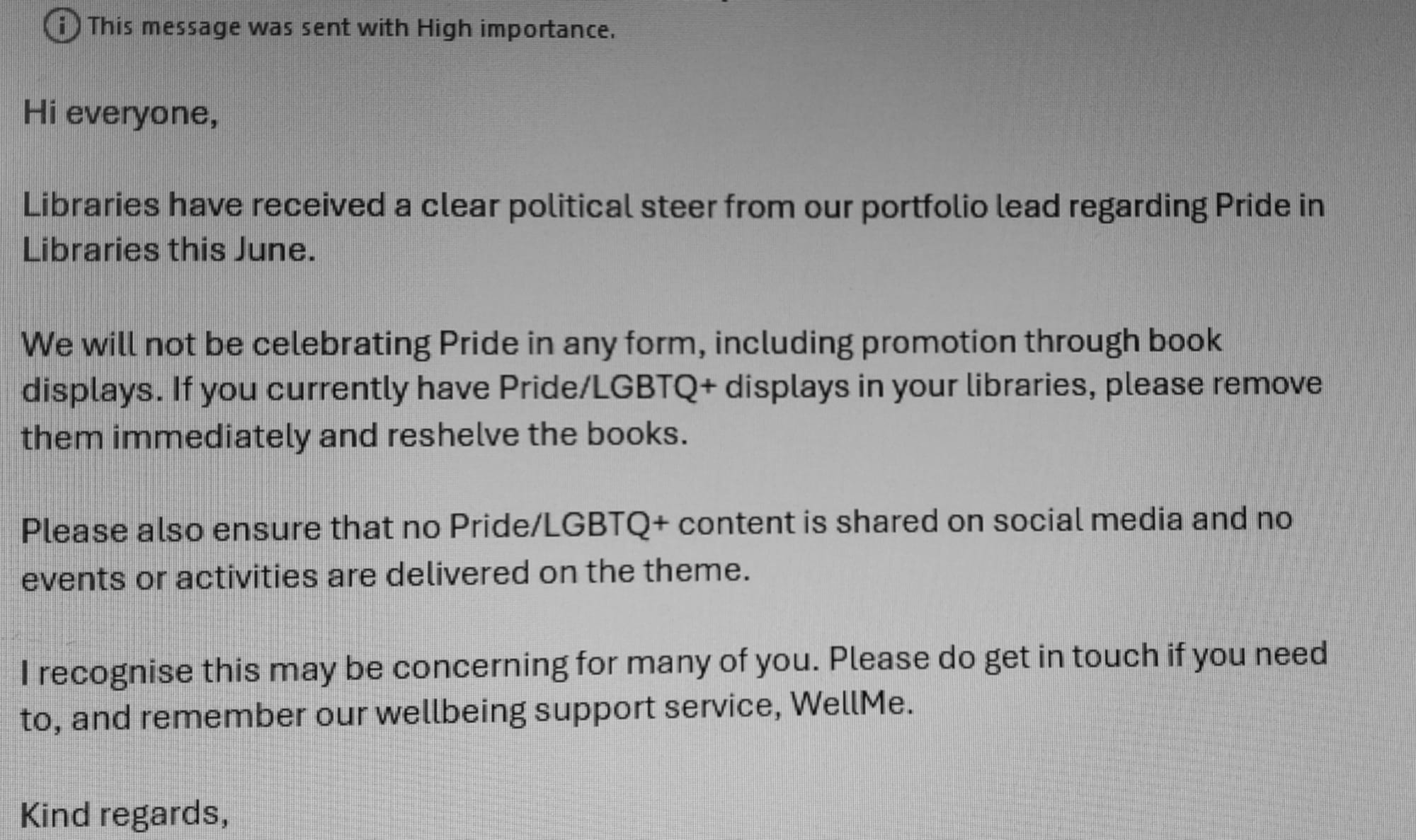
An internal email seen by The Staffordshire Signal shows Staffordshire library staff were told to remove Pride and LGBTQ+ displays, stop Pride-related social media posts and cancel themed activities.
When Staffordshire County Council adopted its new Libraries Strategy earlier this year, it described libraries as "vibrant community hubs" and "welcoming spaces" where people could connect, learn and feel a sense of belonging.
The strategy spoke repeatedly about accessibility, inclusion, community engagement and ensuring that libraries remained relevant to the people they serve. Residents who took part in the consultation praised libraries as safe spaces, valued their inclusivity and highlighted the importance of community provision for people from all backgrounds.
Just four months later, library staff across Staffordshire received an email instructing them to remove Pride displays, stop Pride-related social media activity and ensure that no Pride-themed events or activities took place within libraries.
For many people, those two positions appear difficult to reconcile.
Public libraries occupy a unique position within British public life. They are one of the few genuinely shared civic spaces, used by people of every age, background and political belief. For supporters of the council's decision, the issue is whether publicly funded institutions should remain politically neutral. For opponents, the concern is that removing visibility from one community creates a precedent that could eventually affect others. It is that tension, rather than the displays themselves, which has turned a local library decision into a county-wide debate.
The debate that has followed has often been framed as an argument about books. Social media posts have claimed that LGBTQ+ books were being removed from library shelves, while Staffordshire County Council has repeatedly insisted that no books have been banned and that LGBTQ+ materials remain available to borrow.
Based on the evidence currently available, the council is correct on that point.
The Staffordshire Signal has seen no evidence that LGBTQ+ books have been removed from library stock, withdrawn from public loan or deleted from library catalogues.
However, as this investigation has progressed, it has become increasingly clear that the controversy was never really about books.
Instead, it centres on a different question altogether. Why was Pride singled out?
On 10 June, library staff received an internal email stating that libraries had received:
"a clear political steer from our portfolio lead regarding Pride in Libraries this June."
Staff were instructed that:
"We will not be celebrating Pride in any form, including promotion through book displays. If you currently have Pride/LGBTQ+ displays in your libraries, please remove them immediately and reshelve the books."
The email went further, directing staff to ensure:
"that no Pride/LGBTQ+ content is shared on social media and no events or activities are delivered on the theme."
The wording is important because the instruction was not concerned with library stock. Staff were not told to withdraw books from circulation or remove titles from catalogues. Instead, they were instructed to remove displays, halt events and activities, and cease Pride-related communications.
The distinction matters because it shifts the conversation away from access to books and towards visibility, representation and the role public institutions play in recognising the communities they serve.
The Staffordshire Signal has spoken to multiple members of library staff who requested anonymity because they fear repercussions for speaking publicly.
Several staff members independently told The Staffordshire Signal that a follow-up call was made later that day, which they understood to be a welfare check, but during which questions were also asked about whether displays had been removed.
One member of staff, who identifies as LGBT+, said they now felt unsafe and increasingly worried about speaking openly at work. Others described concerns about the future direction of library services and a fear that publicly challenging decisions could have consequences for their careers.
They told The Staffordshire Signal that, for the first time in their career, they felt their identity had become the subject of a political decision rather than simply part of the diverse communities libraries exist to serve.
Several staff members told The Staffordshire Signal that they were instructed to remove Pride displays and Pride-related social media content immediately. They also said they were unaware of equivalent instructions being issued regarding other awareness campaigns, commemorative events or community initiatives.
That point lies at the heart of the controversy.
Staffordshire County Council's public explanation for the decision has been based on consistency.
In a statement provided to The Staffordshire Signal, Councillor Hayley Coles, Deputy Leader and Cabinet Member for Communities and Culture, said:
"Staffordshire's libraries are for everyone.
They give local people access to books, digital resources, advice, activities and council services, and they are increasingly becoming community hubs where people can learn, connect and get practical support.
As part of that approach, we are applying a consistent approach across our libraries on how public display space is used. Displays will focus on the core library offer, local services, reading and learning.
Our priority is to keep libraries welcoming, useful and accessible to everyone."
The council later clarified that:
"LGBTQ+ materials continue to be available to loan."
Council Leader Martin Murray subsequently addressed the issue publicly, stating:
"No books have been removed from your library shelves. No authors have been pulled from the catalogue. No titles have been placed off-limits."
He also said:
"Our new Staffordshire County Council Libraries Strategy 2026-2028 will focus on core services and will no longer use taxpayer-funded resources, sites and communications channels to promote any particular group, cause or identity."
Councillor Murray added:
"As such, Pride events will no longer be promoted in our public libraries."
The council's position is therefore clear. The decision is not being presented as opposition to LGBTQ+ people but as part of a broader policy of neutrality.
Yet that explanation raises as many questions as it answers.

The Staffordshire Signal has seen examples of libraries promoting Armed Forces Day activities. Libraries have also hosted and promoted VE Day commemorations and a range of community initiatives throughout the year.
No evidence has emerged that staff were instructed to remove those displays. No internal emails have yet surfaced instructing libraries to stop promoting those events. No equivalent directions regarding social media activity have been produced.
If the policy genuinely applies to every cause, every campaign and every identity equally, many residents are now asking why Pride appears to be the first and only example of that policy being implemented.
That concern has spread beyond campaign groups and library users.
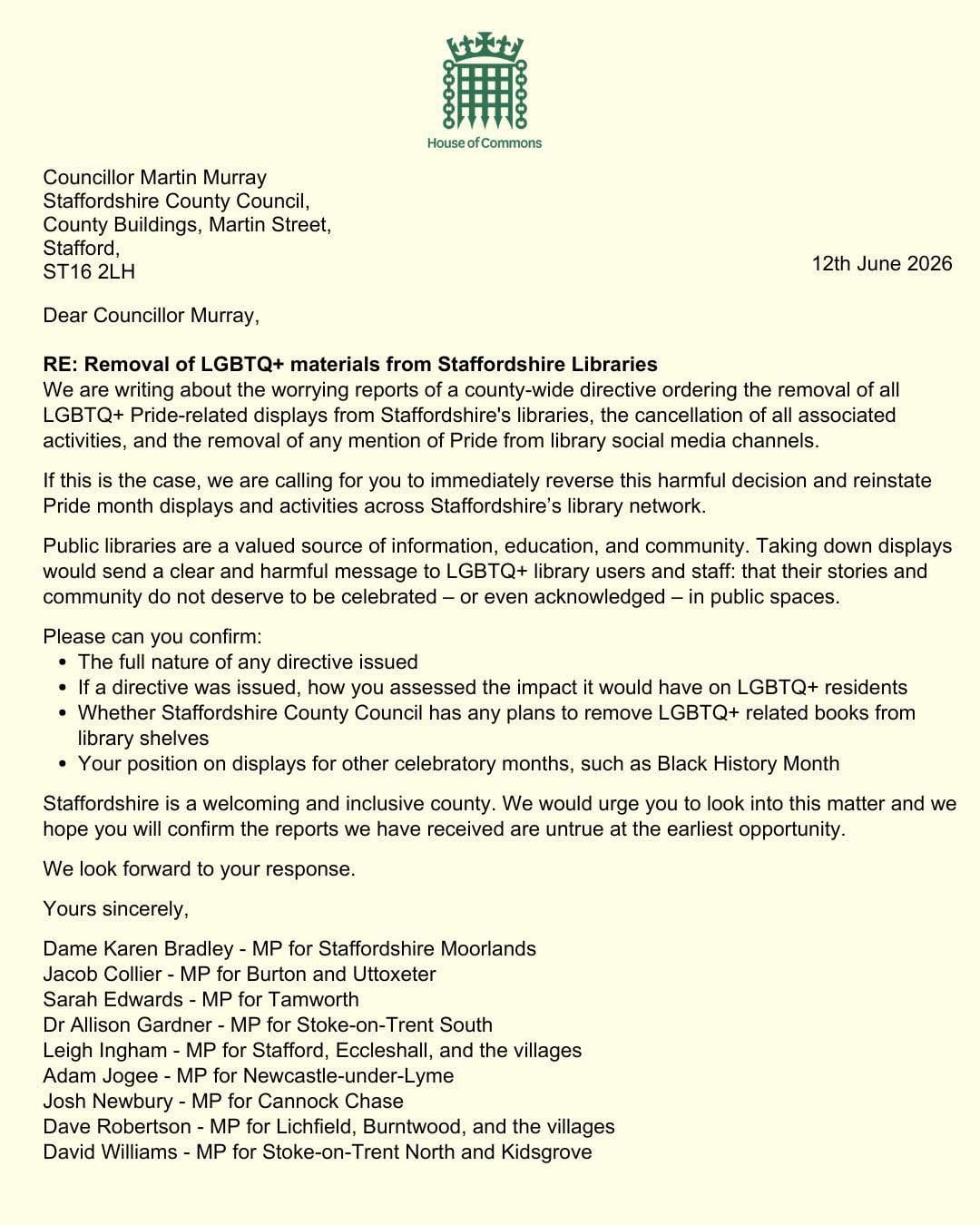
On 12 June, nine Staffordshire MPs wrote jointly to Councillor Murray expressing concern about reports that Pride displays had been removed and associated activities cancelled. The signatories included Dame Karen Bradley, Sarah Edwards, Leigh Ingham, David Williams, Josh Newbury, Adam Jogee, Dr Allison Gardner, Dave Robertson and Jacob Collier.
The MPs described:
"worrying reports of a county-wide directive ordering the removal of all LGBTQ+ Pride-related displays from Staffordshire's libraries, the cancellation of all associated activities, and the removal of any mention of Pride from library social media channels."
They warned that such actions would send a damaging message to LGBTQ+ residents and library users.
Stoke-on-Trent Central MP Gareth Snell was equally critical. In a statement provided to The Staffordshire Signal, he said:
"Libraries should be refuges of the imagination, a place for the pursuit of knowledge and a space where new ideas are discovered."
He added:
"Removing texts and books with LGBT themes is regressive and totally at odds with British values."
The controversy has also attracted attention from Index on Censorship, the international free expression organisation founded in 1972 and known for its work defending freedom of speech, access to information and intellectual freedom around the world.
Responding to questions from The Staffordshire Signal, a spokesperson said:
"Concerns about censorship or intellectual freedom arise when decisions about library materials are driven by ideological / religious / political reasons rather than by transparent policies driven by a professional librarian."
The organisation stressed that not every decision to remove or relocate library materials should be viewed as censorship. Public libraries routinely review stock, replace worn books and make decisions about collections based on demand, relevance and available space.
However, Index on Censorship said the issue becomes more concerning when particular subjects or communities appear to be singled out.
The spokesperson said:
"Not every decision to withdraw a book counts as censorship. Libraries routinely review collections. However, concerns about censorship arise when books are singled out because they address particular themes (LGBTQ+, gender, race, religion or political issues) or when restrictions are imposed without a clear, evidence-based and transparent process."
The organisation also emphasised the wider role public libraries play within society, describing them as places where members of the public should be able to access a broad range of ideas, viewpoints and experiences.
Index told The Staffordshire Signal:
"Libraries are spaces where the public can go to access literature on a wide range of topics and viewpoints. Our intellectual freedom is undermined when materials are removed or restricted because someone or a group of people object to the content or ideas they represent."
While Index on Censorship said it could not comment directly on the specifics of Staffordshire County Council's decision, its comments highlight the questions now being asked by campaigners, library staff and politicians alike. The debate is no longer simply about whether books remain on library shelves, but about how public institutions balance neutrality, representation and access to information, and who ultimately decides where those boundaries should lie.
Meanwhile, community reaction has been swift.
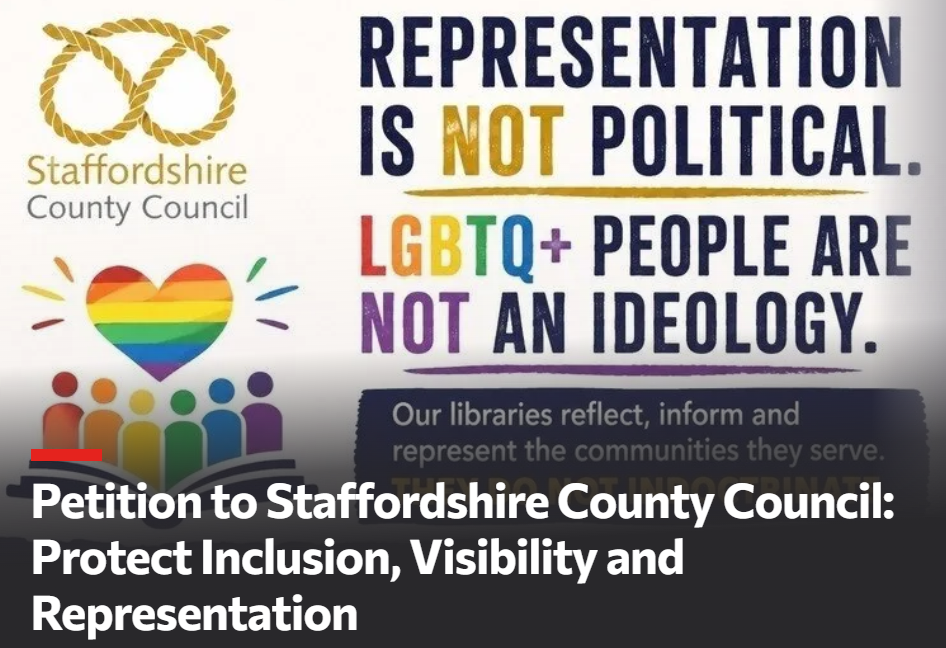
A petition launched by Rainbow Connections calling on Staffordshire County Council to reverse the decision has been started, and supporters argue that representation and visibility should not be treated as political campaigning and point to the council's obligations under the Equality Act 2010.
The Equality Act 2010 identifies sexual orientation and gender reassignment as protected characteristics. The council's objective commits it to considering the experiences of all Staffordshire residents when designing and delivering services and local opportunities. Whether the removal of Pride displays is compatible with that objective is likely to be one of the central questions raised by campaigners and residents in the weeks ahead.
Those obligations are particularly noteworthy because Staffordshire County Council adopted a new Equality Objective in January. The objective commits the authority to consider the experiences of all Staffordshire residents when designing and delivering services and to promote accessibility regardless of people's circumstances.
The council's own Libraries Strategy repeatedly speaks about inclusion, belonging and creating welcoming spaces where people from all backgrounds can connect with their communities. It describes libraries as vibrant community hubs that enrich lives, strengthen communities and provide places where everyone can feel part of something larger than themselves.
It is against that backdrop that many residents, library staff and campaign groups are struggling to understand the decision.
Staffordshire County Council has been clear that LGBTQ+ books remain available to borrow, and council leaders insist the policy is intended to apply equally to all groups, causes and identities. However, the evidence that has emerged so far points in one direction. The only documented instruction seen by The Staffordshire Signal relates specifically to Pride. The only displays known to have been ordered removed were Pride displays. The only social media content known to have been targeted was Pride-related content, and the only activities known to have been cancelled were those connected to Pride Month.
That does not, in itself, explain why the decision was made or what motivated it. What it does do is raise a series of legitimate questions about consistency, transparency and how the council's stated commitment to neutrality is being applied in practice. Those are questions that many people across Staffordshire are now asking, and which the council has yet to fully answer.
The council may ultimately provide answers that satisfy residents.
It may produce a written policy showing that the same approach will be applied to every awareness campaign, heritage month and community initiative in the future.
It may demonstrate that Equality Impact Assessments were undertaken and that the decision forms part of a wider strategy affecting all groups equally.
Until then, however, one question remains at the centre of this debate.
If this policy is genuinely intended to apply equally to every cause, campaign and community initiative, why is Pride the only example that has so far been identified? Until Staffordshire County Council provides fuller answers, that question is likely to remain at the centre of a debate that shows little sign of going away.
Enjoyed this story?
The Staffordshire Signal is a not-for-profit, community-funded publication. Every tip helps keep local journalism free, independent, and focused on the stories that matter across Staffordshire.
Every contribution supports reporting, photography, and storytelling across the county.
Join The Staffordshire Signal on WhatsApp
Never miss a single breaking update, local news story, community event, or deep dive. See everything happening in Staffordshire first, straight to your phone!
Get Instant Updates
Explore the heart of our county Use the interactive map above to discover local landmarks, heritage sites, and community-vetted spots. Every interaction helps support The Staffordshire Signal’s mission to keep local news free and independent.

 Stafford deaf cyclist takes on entire Tour de France Femmes route after mum's blood cancer diagnosis
 DJH Crowned Winners of Knot a Sports Day 2026
 New mum Ellie hoping to get fit and raise funds with Dougie Mac’s Moonlight Walk
 Local Stoke-on-Trent Baker to Take Centre Stage at Foodies Festival Cheshire
 A New Chapter for Middleport Matters and Founder Amelia Bilson