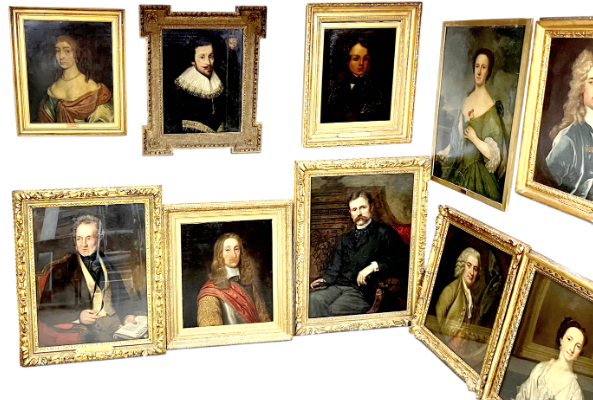
A collection of 22 historic portraits belonging to Staffordshire’s Wolseley family is heading to auction on 3 November, with a combined estimate of up to £70,000. The paintings reveal centuries of family history linked to Wolseley Hall near Rugeley.
Batemans Auctioneers is bringing 22 historic Wolseley family portraits to auction after years in storage.
The paintings preserve the history of one of Staffordshire’s oldest families, whose ancestral home, Wolseley Hall near Rugeley, was demolished in 1966.
The collection has a combined estimate of £50,000 to £70,000, with the auction taking place on 3 November 2026.
A remarkable collection of twenty-two paintings belonging to the ancestral Wolseley family of Staffordshire, are heading to auction this November, offering collectors a rare opportunity to acquire portraits associated with a family whose history stretches back more than a thousand years. The works graced the family seat of Wolseley Hall, that once stood in the civil parish of Colwich, near Rugeley, in Staffordshire, England.
The collection includes portraits of successive generations of the Wolseley family, their wives and relatives, capturing changing fashions, personalities and fortunes across the centuries. Carefully packed away and securely stored since the death of Sir Charles Wolseley 11th Bt. this auction brings a rare historic family portrait collection back to light.
On first seeing the collection unveiled, Managing Director and Senior Valuer at Batemans Auctioneers, Greg Bateman said:
"What makes this collection particularly fascinating is that these are not simply portraits of people from the past. Collectively these paintings tell the story of a family across generations. We are very proud to have been entrusted with bringing these paintings and their remarkable stories to a new audience, where they can be enjoyed once more."
The Wolseley family’s history in Staffordshire
A family of Anglo-Saxon origins, the Wolseleys have roots in Staffordshire stretching back almost a thousand years. Historical records place the family at Wolseley Hall, their ancestral seat near Rugeley, by 1066. Over the centuries, successive generations of Wolseleys, including a distinguished line of baronets, have helped shape Britain’s political, cultural and social history through public service, intellectual achievement and innovation.
The family’s story is one of considerable contrasts, encompassing royal courtiers, parliamentarians, authors, travellers and passionate advocates of religious and political causes, while reflecting the financial challenges of maintaining a large, historic estate. Over several centuries, members of the family made notable contributions to political, intellectual and industrial life. Sir Charles Wolseley, 2nd Baronet (c.1630–1714), served on Oliver Cromwell’s governing Council and was a trusted advisor. He was an advocate of religious toleration and in 1668 wrote Liberty of Conscience which challenged the use of political authority to enforce religious conformity. The later 7th Baronet Sir Charles Wolseley (1769–1846), became a prominent campaigner for parliamentary reform.
In the Irish branch of the family, Frederick York Wolseley (1837–1899), was an Irish-born inventor and woolgrower, who developed the first commercially successful mechanical sheep-shearing machine. Frederick’s pioneering engineering work laid the foundations for the Wolseley motor-car business, with Herbert Austin designing its early vehicles. His elder brother, Field Marshal Garnet Joseph Wolseley, 1st Viscount Wolseley (1833–1913), was one of Victorian Britain’s most distinguished military commanders, serving in campaigns across Burma, the Crimea, India, China and Africa before becoming Commander-in-Chief of the British Army in 1895. A leading advocate of military reform, he earned a reputation for efficiency that gave rise to the expression “All Sir Garnet”, meaning that everything was in order.
Wolseley Hall was rebuilt in the 18th century but suffered a serious fire in the early 1950s. By 1954, the building was in a state of disrepair and had been abandoned by the family, who moved to nearby Wolseley Park House. The hall was eventually demolished in 1966. The estate was sold in 1996, bringing to an end the family’s long association with the property. Against this backdrop, the surviving portraits are particularly evocative. They preserve the likenesses of individuals who inhabited the hall, shaped its history and witnessed the changing fortunes of the family over several centuries.
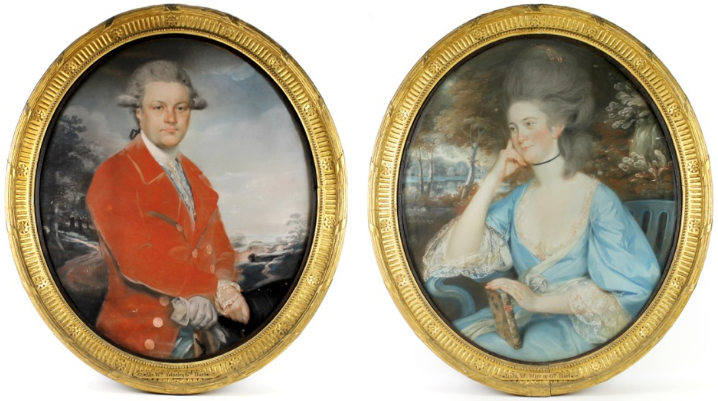
Among the highlights is a distinguished pair of pastel portraits of Sir William Wolseley, 6th Baronet, and his wife, Lady Charlotte Wolseley, dated 1778. Painted by John Russell, R.A. (British, 1745–1806) and signed by him, both portraits depict their sitters in half-length, with Sir William wearing a red jacket and Lady Charlotte dressed in a blue silk gown, holding a book in a contemplative pose. Presented in substantial gilt reeded frames with title plaques, the pair offers an elegant insight into Georgian portraiture and the world of an aristocratic family at the height of its social standing.
Sir William, born in 1740, served as a Gentleman of the Privy Chamber to King George III, following in his father's footsteps. He was known for his wit and sociability and belonged to the Nameless Club, whose members included figures such as David Garrick, Oliver Goldsmith and Dr Samuel Johnson. Yet his reputation for gambling and extravagant spending also contributed to the loss of substantial portions of the family estate and its possessions. His marriage to Lady Charlotte Chambers was a love match and the couple had twelve children. Both were buried at Colwich Church, Staffordshire.
The portraits offer a compelling juxtaposition of Georgian elegance and the more complicated personal history behind the family. The pair carries an estimate of £15,000–£25,000 (Lot 173).
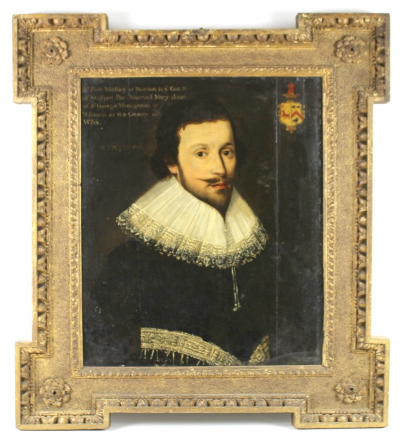
An important 17th century British School portrait depicts Sir Robert Wolseley, 1st Baronet (1587–1646), identified by inscriptions on the painting as a baronet of Staffordshire, aged 33. Shown facing forward in black clothing with an elaborate lace collar and cuffs, he is accompanied by an inscription recording his marriage to Mary, daughter of Sir George Wroughton of Wilncote, Wiltshire. His coat of arms is also recorded on the panel.
The portrait relates to a pivotal period in the Wolseley family’s history. Robert Wolseley was created a baronet by King Charles I in 1628. Having advanced from a position in his father's town clerk's office to a royal appointment, he acquired the Wolseley estate in 1629 after lending money to his cousins to settle fines associated with their Catholic faith. An ardent Royalist, his fortunes subsequently suffered when the estate was sequestered by Parliament during the Civil War. The painting is a striking survival from the 17th century, combining the formal conventions of early British portraiture with a direct connection to the family's inheritance history. It carries an estimate of £4,000–£6,000 (Lot 169).
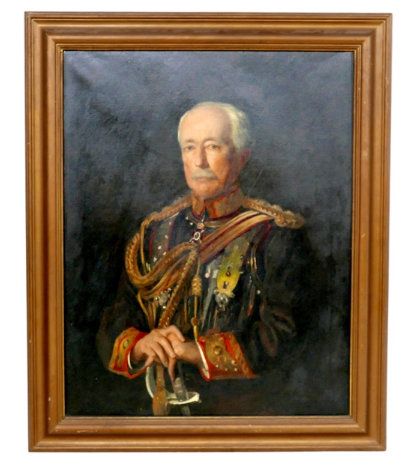
Also among the highlights is a striking half length portrait of Field Marshal the Right Honourable Garnet Joseph Wolseley (1833–1913), 1st Viscount Wolseley, painted by William Alan Menzies (British, 1865–1929) after the original by E. Fuchs. Depicting Wolseley in ceremonial military uniform adorned with decorations, the portrait commemorates one of Victorian Britain’s most prominent military commanders and influential army reformers. Inscribed on the back: “Lord Wolseley F.M 1905 after E Fuchs by W A Menzies”, the painting retains its artist’s label and is presented in a plain gilt frame.
Garnet Wolseley served as Commander-in-Chief of the British Army from 1895 to 1901, overseeing a period of significant military reform and modernisation. His distinguished career took him across Burma, the Crimea, India and China, as well as to Canada and Africa, where he commanded military expeditions. His reputation for military efficiency became embedded in the English language through the expression “All Sir Garnet”, meaning that everything was in order.
His legacy also extended into popular culture. Wolseley inspired the character of Major-General Stanley in Gilbert and Sullivan’s comic opera The Pirates of Penzance, whose celebrated song, “I Am the Very Model of a Modern Major-General”, drew on the image of the highly accomplished Victorian military leader. A member of the Irish branch of the Wolseley family, he brings a significant military and cultural connection to this important collection. It carries an estimate of £1,000–£2,000 (Lot).
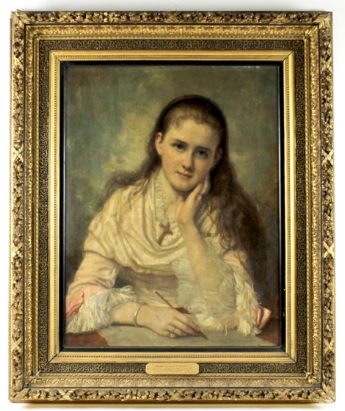
A later portrait by George Peter Alexander Healy (American, 1813–1894) depicts Anna “Nannie” Theresa Murphy, who became Lady Wolseley through her marriage to Sir Charles Wolseley, 9th Baronet, in 1883. Painted in 1876, before her marriage, the half-length oil portrait shows Anna wearing a white dress with large cuffs, a cross-shaped pendant, a silver bangle and rings, with a pencil held in her right hand. Signed and dated by Healy, the painting retains its gilt gesso frame and a period depository label to the reverse.
Anna was the daughter of Daniel T. Murphy of Murphy Grant & Co. San Francisco and belonged to the world of wealthy American heiresses whose marriages to members of the British landed elite became a feature of the late 19th-century social landscape. The marriage was intended in part to help address the financial difficulties affecting the Wolseley estate. However, the full marriage settlement was disrupted by her father's sudden death, followed by legal disputes with her siblings. A keen traveller, Anna was an independent figure whose marriage provides a fascinating glimpse into the transatlantic relationships, financial pressures and social ambitions of the Victorian aristocracy. It is estimated to fetch £600–£800 (Lot 160).
Portraits that reveal the people behind the titles
Beyond the principal highlights, the collection offers an unusually personal view of the Wolseleys and their wider family circle. The sitters’ stories encompass political conviction, religious devotion, literary achievement, international travel, romance and adversity.
Among them is William Somerville (1675–1742), the poet and author of The Chase, published in 1735, a celebrated poem exploring hunting and offering an insight into country life in the 18th century. Other portraits relate to Sir Charles Wolseley, 2nd Baronet, a prominent political figure who served during Oliver Cromwell’s Protectorate and wrote on religious subjects, and Sir Charles Wolseley, 7th Baronet, who travelled through revolutionary France and became involved in the movement for parliamentary reform in Britain.
The collection also touches on the experiences of women whose lives were shaped by the expectations of their time. Lady Charlotte Wolseley, mother of twelve, found much of her life centred on the family estate and her religious convictions. Mary Anne Selby, wife of the 8th Baronet, faced considerable hardship after her husband's early death, travelling through Europe with her children before the family was eventually able to return to Wolseley.
Such histories lend the collection a significance beyond its artistic interest. Each portrait offers a starting point for understanding the individuals behind the family name, while the group as a whole creates a visual record of an ancestral line and the changing world in which it lived.
A rare opportunity to reconnect with the past
For Batemans Auctioneers, the collection represents an opportunity to bring a significant group of family portraits back into public view after years in storage.
“Collections like this remind us why provenance and historical research matter so much,”
added Greg Bateman.
“The inscriptions, the identities of the sitters and even the personal notes on the reverse of a painting can transform what might initially appear to be a traditional family portrait into a fascinating historical document. These works connect us directly with the people who lived at Wolseley Hall and allow us to explore their stories in a very tangible way.”
The twenty-two paintings will be offered in Batemans’ Curated & Collectable Sale on November 3, 2026 with a combined estimate total of £50,000–£70,000 and individual estimates ranging from £100 to £25,000.
The collection presents opportunities for a wide range of collectors, from those seeking an accessible piece of British family history, to buyers interested in important historic portraiture.
 Why the Signal exists
Real news takes time. Thanks for taking yours.
You've just read a story that took time to get right. No clickbait, no racing to be first, no ads chasing you down the page.
I started The Staffordshire Signal because I got fed up of local news that chased clicks instead of stories. We're independent, not-for-profit, IMPRESS-regulated and owned right here, so we answer to nobody but you.
The honest bit: local news only survives if local people choose it. If we don't, it goes.
Jenna GoodwinFounder and Editor, The Staffordshire Signal
Love what we do?
Buy us an oatcake! Cheese and bacon, if you're feeling generous. Every tip goes straight into local reporting.
Buy us an oatcakeMiss a proper paper?
Staffordshire's only regional printed magazine, full of stories worth sitting down with, delivered to your door.
Get it deliveredFollow on WhatsApp
Our stories, dropped straight into your phone. No group chat chaos, we promise.
Join the channelFind something good to do this week
Markets, gigs, history talks and family days out across Staffordshire. Running an event? Add it to our guide and let the county know.
Run a Staffordshire business?
Our readers keep the Signal going, and the businesses who advertise with us help keep it free for everyone. Reach people who read to the end, across our magazine, Signal Weekly, Signal TV and website.
Explore the heart of our county Use the interactive map above to discover local landmarks, heritage sites, and community-vetted spots. Every interaction helps support The Staffordshire Signal’s mission to keep local news free and independent.

 Newcastle-under-Lyme Lantern Parade returns this December
 Ofsted recognises strong support for care-experienced young people in Stoke-on-Trent
 Local news in Staffordshire is changing, and it’s about time
 Mediaeval Baebes Celebrate 30 Years of Enchantment with Torchlit Procession and Special Anniversary Concert in Stoke Minster
 What Is IDD Therapy? Andrew Wade Explains the Treatment for Chronic Back and Neck Pain