Historic England has raised concerns over demolition plans at Spode Works, questioning whether the loss of several historic buildings has been justified.
Of everything raised during the consultation on Capital & Centric's plans for Spode Works, the response objectors have been waiting for longest is the one that arrived last: a formal letter from Historic England, dated 21 August 2026. Historic England is the government body that advises on England's historic buildings, it's their job to tell councils whether a development harms something worth protecting, and how much that matters. Their letter is the single most important document in this whole planning story so far, but it's also written in planning language that doesn't mean much if you don't do this for a living. So here's what it actually says, in plain terms.
A quick reminder: what's actually being proposed
Capital & Centric want to redevelop part of the old Spode Works site. Some buildings would be repaired and reused, some new ones added (including padel courts and a café), and a number of the old factory buildings would be knocked down completely. This article focuses on that last part, the demolition, because it's what Historic England's letter is mostly about.
Why buildings that don't look "listed" are actually protected
Here's the bit that surprises a lot of people. The buildings due to be demolished, known by codes like 8P, 8T and 8V rather than proper names, don't appear on the official heritage list in their own right. If you looked them up individually, you might not find them at all. So why does it matter that they're being knocked down?
The answer is something called "curtilage listing." Think of it like this: when a building is given listed status, the protection doesn't stop at that one building's front door. It also covers other structures within its grounds, its "curtilage", as long as those structures have been there since before 1 July 1948. So even a fairly ordinary-looking outbuilding or shed can end up legally protected, simply because it's stood next to a listed building for long enough.
That's exactly the situation here. The main listed building at Spode (a group of structures near the Church Street entrance, officially Grade II listed) has these demolition-target buildings sitting within its historic grounds. So legally, knocking them down isn't like demolishing a random old shed, it counts as altering part of a listed building.
We know this isn't just a technicality because of the paperwork itself. Alongside the normal planning application, Capital & Centric also had to submit something called a Listed Building Consent application. You only need one of those if you're doing work to something that's actually listed. The fact that one exists, covering exactly these buildings, is the developer's own confirmation that this protection applies.
Worth being precise here, though: not every single building carries the same confirmed status. The developer's own heritage report describes some, like 8P, as definitely "listed by curtilage." Others, like 8L, are described only as "potentially" curtilage listed, and a few, including 8N and part of 8K, are said not to be curtilage listed at all, they're protected only because of how they sit within the wider listed setting, a related but slightly weaker form of protection. The overall picture, that this counts as work to a listed building, still stands, but it isn't a uniform status across every building on the demolition list.
What Historic England actually said, in plain English
The bits they like: Historic England is happy with the overall idea of bringing this part of Spode back to life. They specifically welcome the plan to repair, rather than demolish, the buildings known as 8S and 8U (their letter actually says "8S and 8V," but that looks like a typo on Historic England's part, since 8V is the building they go on to say they're worried about demolishing a few paragraphs later, and every other document, including the application itself, only proposes repairing 8S and 8U). They're also pleased that one particular building, called Gordon House, a 1960s shop building that isn't historic itself, is coming down. They say removing it will let people actually see the China Halls building properly for the first time in years, and will let the Rose Garden next door be made bigger.
The bit they don't like: Their concern is specific, not sweeping. They're not objecting to the whole scheme, just to how much is being knocked down, and whether the reasons given stack up. In their own words: "We have concerns over the level of demolition of buildings proposed, and the justification for their removal."
They point to three specific parts of the plan where they think the developer hasn't made a strong enough case: part of a building called 8E, part of a building called 8T, and a building called 8V. For 8T, they say the developer hasn't properly explained what will replace the demolished part, or why it needs to go at all. For 8E, they'd rather see it kept whole unless a much better reason is given for removing part of it.
The most damaging point in the letter: This is the one that matters most. Capital & Centric commissioned their own engineers to check the condition of the buildings before applying to demolish them. That report, done by a firm called Stand Consulting Engineers, is the developer's own evidence, not an objector's. Historic England quotes it directly: the buildings "are in a very poor condition due to water ingress and past poor maintenance, but it is nevertheless structurally feasible to retain and repair with some rebuilding." In other words, the developer's own expert says these buildings could be saved. Historic England is essentially asking why they aren't being.
One more concern, about what replaces the demolished buildings: Once some of these buildings come down, the plan is to fill the space with padel courts (a racket sport a bit like a smaller, enclosed version of tennis). Historic England isn't against padel as such, but they worry that permanently filling that new open space with courts will actually make the area feel more cramped and less welcoming than leaving it open would, and could get in the way of other businesses who might want to use that space.
Their overall conclusion: Historic England says the application, as it currently stands, contains some harm to the site's heritage value that they don't think has been properly justified. That's a formal, technical finding, referencing specific government planning rules (the "National Planning Policy Framework"), and it carries real legal weight with the council. But they end on a constructive note, saying they want to keep working with the council and the developer to sort out these issues, and expect more information and another round of consultation before this is settled.
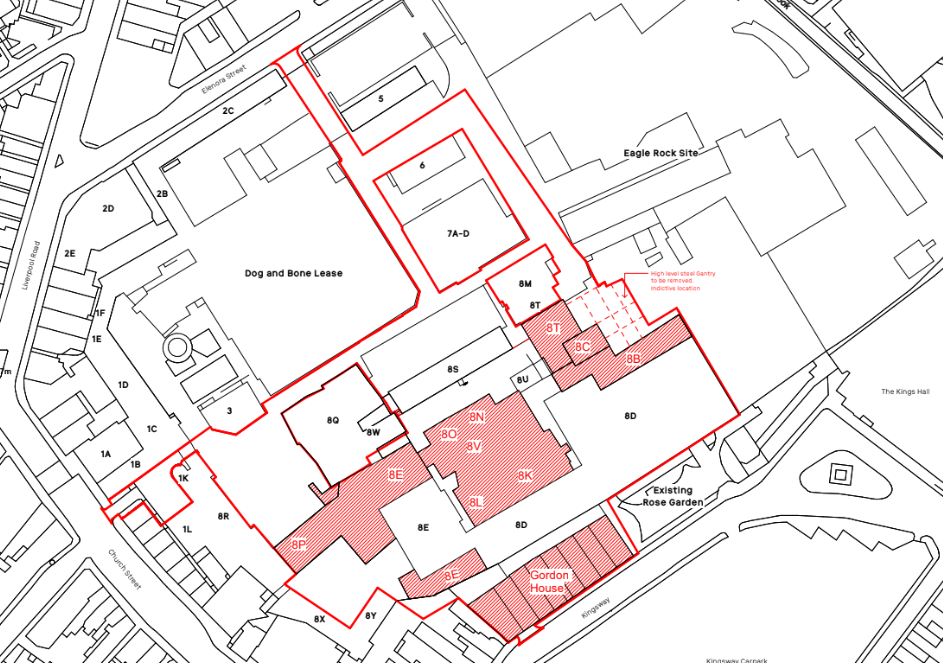
What's happening to each building, in plain terms
- 8K and 8L — Built between the 1920s and 1970s. Not historically important on their own, and boxed in by other buildings around them. Historic England hasn't objected to these coming down.
- 8N and 8O — 1950s sheds. The developer's own heritage report describes 8O as having "no architectural or historic features," and assesses 8N in similar terms. Neither is challenged by Historic England.
- 8V — An older building, from the late 1800s to 1920s, once used for making moulds and storage. It's genuinely in bad shape, part of it has already collapsed, and it's currently being held up with temporary props. It's still one of the three buildings Historic England wants a better explanation for demolishing.
- 8C — One of the oldest buildings on the whole site, dating from before 1833. Sadly, its roof has already caved in and it's not safe to go inside. The developer argues that, in its current ruined state, it's actually making the area look worse rather than better. Historic England hasn't disputed this one.
- 8P — This one stands out because, unlike every other building, it doesn't get its own detailed write-up in the developer's heritage report. ACAVA studio holder Paul Riley had already told us it was linked to his organisation, pointing to the application's own drawings, which show 8P's stairwell entrance and individual studio spaces. We put this to Capital & Centric directly, and they've now confirmed occupancy themselves, and gone further: they won't demolish the building until a new space is ready for those artists to move into, "We won't be able to demolish it without creating a new facility for the artists to move to. If they don't want to, then we won't demolish the current building."
- 8T and 8E (parts of) — The other two buildings Historic England has specifically asked for a stronger case on.
- Gordon House — Not actually part of the old pottery factory at all. It was built in the 1960s as shops with offices above, on the site of a much older theatre and cinema. It isn't listed, and both the developer and Historic England agree that taking it down is a good idea in heritage terms. One thing still needs resolving first, though: the council's own ecology adviser has flagged that the bat survey for this building hasn't been completed, so it can't be signed off until that's done.
So what happens now?
In practical terms, Historic England's letter means the application can't simply be approved as it stands. The council legally has to take this advice into account, and Historic England themselves have said they expect "further information, clarification and re-consultation," planning-speak for the developer likely needing to go back, answer these concerns properly, and possibly let people have their say again on any changes.
Historic England's letter is specifically about the Listed Building Consent application, 26/LBC/00612, and that application has its own deadline, 11 September 2026, sooner than most people following this story probably realise. (The separate full planning application, 26/FUL/00608, has a later deadline of 16 October 2026, but the two are linked, and neither can really move forward on its own.) Combined with a separate objection from the council's own highways team (about traffic and parking, a different issue we will cover soon), it looks increasingly unlikely either application will be decided on time without some kind of delay or amendment.
Have information relevant to this story? Get in touch: jenna@thestaffordshiresignal.co.uk
Support local journalism
Help us grow the Signal
Every tip goes towards expanding what we cover, more reporters, more events, more of Staffordshire's stories told properly. If this was worth reading, help us do more of it.
Every contribution supports reporting, photography, and storytelling across the county.

 First Signal TV documentary nears completion as students and miners bring Staffordshire's history to life
 Not all heroes wear capes - care home searches for Stafford champions
 Adult learning move to improve facilities and access to employment support
 Emmaus North Staffs partners with Little Steps Big Dreams to further expand community support
 City council steps in to protect Stoke’s historic Falcon Works