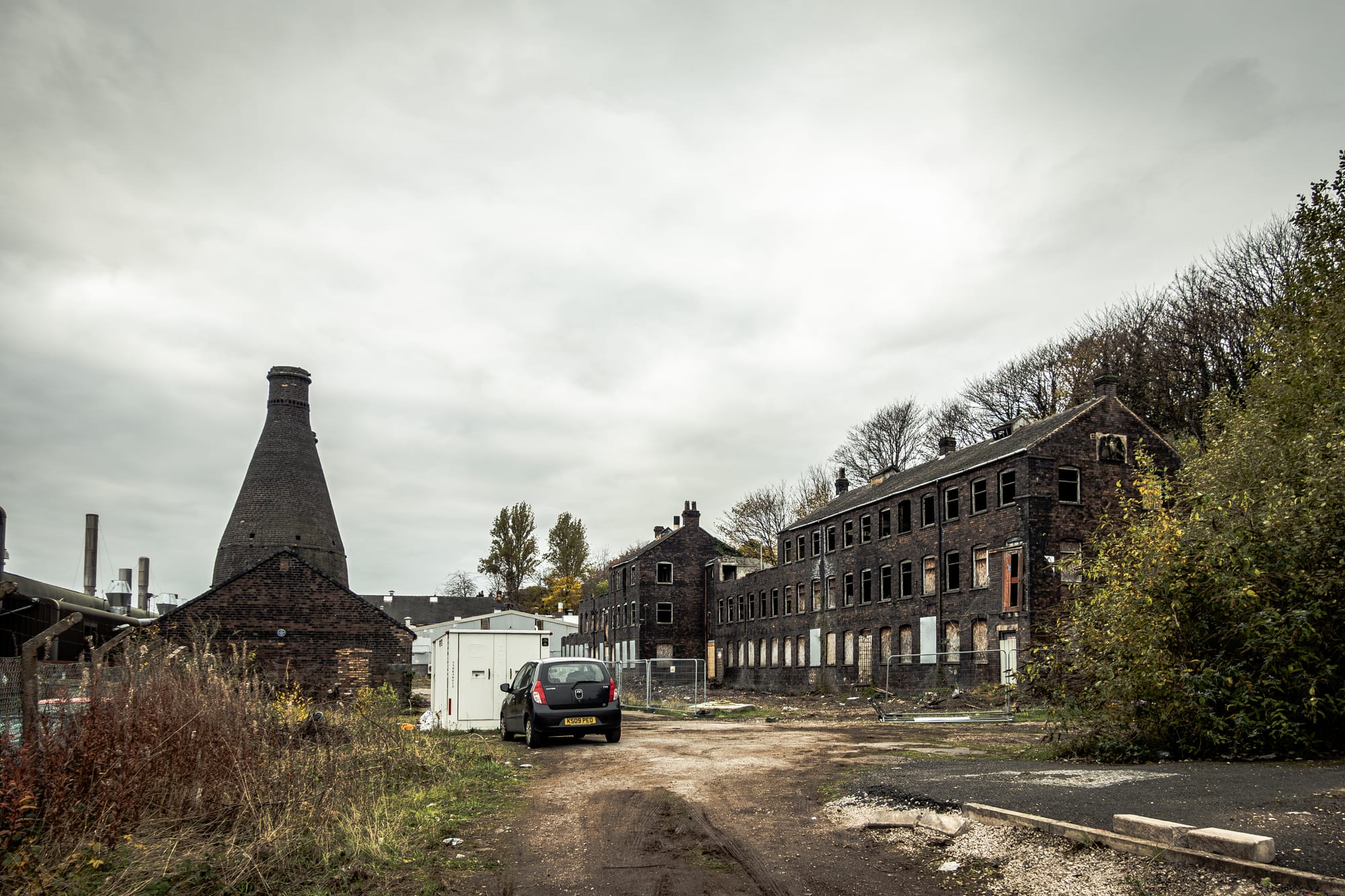
The council has ordered urgent repairs at the Goss family's historic Stoke potbank. We look at how Falcon Works got here, and at five other bottle oven and potbank sites with open enforcement cases.
What's new: Stoke-on-Trent City Council has served an urgent works notice on the owners of Falcon Works, the Grade II listed home of W.H. Goss crested china, and the owners must set out how and when they will carry out repairs by 23 November.
By the numbers: Falcon Works has stood empty for more than 35 years. It is one of six bottle oven and potbank sites with open enforcement cases, out of more than 100 heritage cases the council has dealt with in the past year.
Why it matters: Stoke-on-Trent once had around 2,000 bottle ovens. Only a few dozen survive, and once they are gone, they are gone for good.
What is happening at Falcon Works?
On 27 October, Stoke-on-Trent City Council served an urgent works notice on Diwan Property Development Ltd and other interested parties, under Sections 54 and 55 of the Planning (Listed Buildings and Conservation Areas) Act 1990.
The notice covers the Grade II listed buildings at Falcon Works on Sturgess Street, Stoke. The works it requires include:
- securing the site with perimeter fencing;
- boarding up open windows and doorways;
- clearing vegetation, rubbish and debris;
- repairing and replacing damaged gutters and downpipes;
- putting temporary roof coverings over areas where roofs have collapsed;
- supporting unstable walls and masonry at risk of collapse;
- carrying out emergency repairs to the kiln buildings.
The owners have until 23 November 2026 to submit their proposals and a programme of works. The council has been clear that this is not a deadline for every repair to be finished, but for the owners to show how and when they will do the work.
The council told The Staffordshire Signal there has been contact from the owners since the notice was served, and that it will continue to work with them.
If the owners do not act, the council says it intends to step in and carry out the work itself, recovering the costs from the owners. Exact timescales depend on whether a proposal arrives by the deadline, but the council says it is preparing for that eventuality.

The story of Falcon Works and W.H. Goss
Falcon Works was established in 1858, and is best known as the home of William Henry Goss, whose name became famous around the world for crested souvenir china.
Goss first ran his business from the Cock Works on Leese Street, before moving to Falcon Works on Sturgess Street around 1870. The surviving buildings date from his time on the site.
The factory built its reputation on ivory, jewelled and heraldic porcelain. Goss pioneered the Victorian and Edwardian craze for crested souvenir trinkets, small pieces of china carrying the coat of arms of a town, school or institution. For a generation of day trippers and holidaymakers, a piece of Goss was the souvenir to bring home, and collectors still seek it out today.
It was very much a family business. William's son Adolphus joined the firm in 1883, leaving in 1900. When William Henry Goss died in 1906, his sons Victor Henry and William Huntley Goss took over.
Victor's death in 1913, and dwindling family involvement afterwards, marked the start of the end. Cauldon Potteries Ltd bought the business in 1929, and in 1934 it was renamed the Goss China Co. Ltd. Pottery production at Falcon Works finally stopped in 1944.
The Goss story did not quite end there. The moulds and engravings were acquired by the Lawley Group in 1956, and Royal Doulton briefly revived the Goss trademark in 1985.
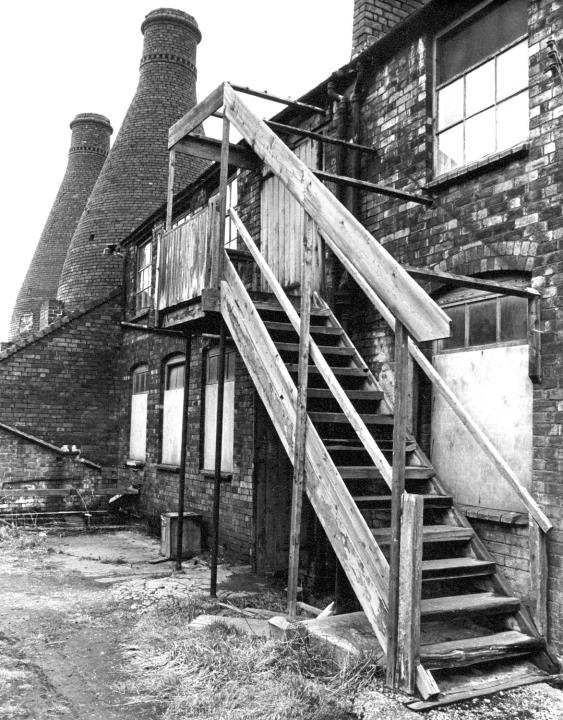
Falcon Works.Pottery factory exterior including bottle ovens and an exterior wooden staircase.Exterior stairs were a feature of pottery factories. Workshops tended to be separate rooms with separate entrance doors.There ...View Full Resource on Staffordshire Past Track
Why the site matters
In August 1979, the surviving glost kilns, the stone carving of the Goss goshawk and the warehouse buildings were designated Grade II listed.
The site includes two bottle ovens, both updraught ovens of the stack type, where the chimney is built directly on top of the firing chamber. Together with the goshawk, the falcon-like bird that gave the works its name and became the Goss emblem, they make Falcon Works one of the most recognisable surviving potbanks in the city.
Councillor Finlay Gordon-McCusker, cabinet member for growth, regeneration and transport, said: "Falcon Works is an important part of our ceramics heritage and its continued deterioration cannot be allowed to continue."

A site in decline
Falcon Works has changed hands several times since production ended in 1944 and has been vacant for more than 35 years. A number of redevelopment ideas have come and gone without success.
In 2022, the site was badly damaged by fire.
A previous enforcement notice, requiring repairs and maintenance to stop the buildings deteriorating further, was not complied with. In September, the council stepped in to secure the site itself after those responsible failed to act. It says those costs will be recovered from the owner, and a charge has been placed on the land.
The Staffordshire Signal has asked the council how much those safety works cost and whether any of the money has been recovered.
What could happen next?
In the short term, everything hinges on 23 November. If acceptable proposals arrive, the owners carry out the work. If they do not, the council steps in and sends them the bill.
In the longer term, the council says a number of options remain open and it intends to keep all of them open, with the ultimate aim of giving Falcon Works a sustainable future.
Asked whether a compulsory purchase was on the table, the council said a CPO cannot always be the answer, and that another route could be a debt transfer.

The other bottle oven and potbank sites on the council's list
Falcon Works is not alone. The council currently has open enforcement cases at six bottle oven and potbank sites, not all of which still have a bottle oven standing. Here is what we know about the other five.

H Aynsley's works, Commerce Street, LongtonThis photograph of Herbert Aynsley's Commerce Street Works was taken from the corner of Millbank Street (previously Union Street) with the centre of Longton off to the right. Formerly known as Chetham ...View Full Resource on Staffordshire Past Track
Commerce Street Works, Longton (Grade II)
Tucked inside a workshop range in the Longton Conservation Area, the Commerce Street Works keeps a pair of bottle ovens of the skeleton type, dating from the late 19th century.
The pottery was founded by Chetham and Woolley in 1796, and the Chetham family ran it until 1869. H.J. Aynsley took over in 1873, and the works was associated with Aynsley for much of its history.
The two ovens are only a small part of what was once a much larger works. They were listed in March 1989. The firing chambers inside have since collapsed, and the site is now classed as a development site.

Hill Works, Westport Road, Burslem.The Hill Works was built in 1814 on what was then called Liverpool road (now Westport Road), the major road through to Tunstall and the port of Liverpool. This area was known as The Sytch. It was opposite ...View Full Resource on Staffordshire Past Track
Royal Victoria Pottery, Burslem (Grade II)
The Royal Victoria Pottery on Westport Road began life in 1814 as the Hill Works, built for the potters John and Richard Riley. Pevsner rated it as having some of the best pottery offices and warehouses he had seen.
It passed to Samuel Alcock and Co. in 1830, then to Dunn, Bennett and Co. in 1888, who made hotel and railway china there for decades. Wade Heath and Co. took over in 1954, and as Wade Ceramics the firm made its famous Whimsies on the site.
Wade moved to a new factory in Etruria in 2010, and the site was later sold for housing development. It has stood derelict ever since, and fire has returned again and again: an arson attack in 2013, then a blaze started by a stray firework in 2017.
The worst came on 27 April 2025, when an arson attack destroyed much of the roof. Six fire crews, more than 30 firefighters in all, were called to Westport Road.
Part of Westport Road was closed for months afterwards. The site's owner, Miller Homes, carried out emergency repairs and demolished parts of the badly damaged four-storey building to bring its height down, then put up scaffolding so the road could reopen. Those emergency works have since been granted retrospective listed building consent.
In October 2026, the council ordered further urgent works after inspections found more parts of the structure posed a safety risk, and demolition of those sections began on 19 October. The council says its notice covers only the elements identified as unsafe, not the whole building, and does not include the listed frontage onto Westport Road or the former Sunday School frontage.
There are no bottle ovens on the site; it is on the council's list as a historic potbank.

Middleport Mills, Pidduck Street, MiddleportThis photograph was taken from Milvale Strteet with Pidduck Street going off to the right down to the Trent & Mersey Canal. This was a calcining mill built largely in the early 19th Century, bordering ...View Full Resource on Staffordshire Past Track
Former Calcining Works and Morrilew Pottery, Middleport (Grade II)
The council's list calls this site the "Former Clancing Works and Morrilew Pottery". It appears to mean the former calcining works on Milvale Street, Middleport, beside the Trent and Mersey Canal, where a sign reading Morrilew Pottery has been photographed on one of the outbuildings.
Strictly speaking, its kiln is not a bottle oven. Calcining kilns did not fire pottery: they roasted flint and animal bone so it could be ground and mixed into clay. This one is square in section, with two firing chambers whose flues meet only at the top.
The works dates mainly from the early 19th century, with later additions, and was listed in November 1992. By 1907 it was Middleport Mill, run by Goodwin's Mill Co., grinding flint, stone and other materials for the potbanks.
The larger Morrilew Pottery buildings on the same site were demolished after a fire several years ago. What remains is largely derelict, within the Trent and Mersey Canal Conservation Area..

Price's National Teapots, Trubshawe Cross, Stoke-on-TrentPrice's National Teapots factory, also known as Top Bridge Works, from the Newcastle Street bridge over the Trent & Mersey Canal at Trubshawe Cross. This grade II listed building has been occupied by ...View Full Resource on Staffordshire Past Track
Price and Kensington (Top Bridge Works), Longport (Grade II*)
Sitting beside the Trent and Mersey Canal at Longport, the Top Bridge Works is among the most important industrial buildings in the city. It was built in the 1790s and, alongside the Spode factory, is the earliest surviving example of a fireproof pottery works.
It was part of the Davenport family's Longport empire, before Thomas Hughes bought it around 1881. Price Brothers moved in from Burslem in 1903, and it became known as the home of Price's National Teapots. In 1962, Price Brothers merged with Kensington Pottery to form Price and Kensington Potteries Ltd, and teapots were made there until the Arthur Wood Group went into administration in 2003.
Its single updraught bottle oven, of the hovel type, dates from around 1830 and was restored in 2004. The rest of the works has not been so lucky. It has been on Historic England's Heritage at Risk register since 1998, part of it was demolished by the council in November 2019 after surveys found parts at risk of collapse, and Historic England has described its condition as very bad, following fires and heritage crime.
There is now real hope for its future. Local businessman Wayne Walker, who owns the neighbouring Wayne Walker Quality Meats factory shop, bought the whole Top Bridge Works site in 2024. He has unveiled plans to turn it into a shopping village with a cafe, cash-and-carry and beer warehouse, and has said he is working closely with the council and conservation officers. By May 2024 the site had been cleared and restoration work was under way.

The Co-Operative Pottery Depot, Goldenhill Road, LongtonThe crockery depot stood on the corner of Goldenhill Road and King Street on the edge of Longton. The Co-Op operated potteries such as the Windsor Pottery and the Crown Clarence Pottery in Longton. The ...View Full Resource on Staffordshire Past Track
The Potbank, 445 King Street, Longton (not listed)
The only site on the list without listed status, 445 King Street stands on the corner of King Street and Goldenhill Road, on the edge of Longton. It was once the Co-operative Pottery Depot, where the Co-op kept its crockery. The Co-op ran its own potteries in Longton, including the Windsor Pottery and the Crown Clarence Pottery.
A photograph taken by Bert Bentley in December 1962 shows the depot with a longer range of buildings beside it. The corner building still stands, but that range has since been demolished. More recently, the property, described as two former factories, has been marketed for sale as a development opportunity.
Because it is not listed, it does not have the same statutory protection as the other five sites, which makes the council's interest all the more notable.

Bottle Ovens - Earnshaw's.Pottery factory exterior including bottle ovens.Thick black smoke from bottle ovens was a common sight in Stoke-on-Trent as the pot banks fired their ware.Taken at Earnshaw's pot bank, Stoke-on-Trent.Taken ...View Full Resource on Staffordshire Past Track
Why bottle ovens matter
Bottle ovens are the defining image of the Potteries. Pottery was fired inside them in coal-fired chambers, protected by the tall brick hovel that gave them their famous shape and drew the heat upwards.
At their peak, between 1,500 and 2,000 bottle ovens and kilns stood in Stoke-on-Trent, and smoke from them could make it impossible to see across the street in Burslem or Longton.
The Clean Air Act of 1956 sealed their fate. Manufacturers were given seven years to switch to cleaner fuels, and firings had stopped by the end of 1963. A single ceremonial firing, the last ever in a traditional coal-fired bottle oven, took place at Longton in 1978.
Today only a few dozen survive across the city, all of them listed, and many are in private hands. Each one lost takes a piece of the city's skyline, and its story, with it.

The Heritage Emergency
The action at Falcon Works is part of the council's Heritage Enforcement Programme, which has dealt with more than 100 heritage-related cases since activity was stepped up around 12 months ago, when the city declared a Heritage Emergency.
Councillor Jane Ashworth, leader of Stoke-on-Trent City Council, said: "Falcon Works is one of the most significant surviving historic pottery sites in our city and we are determined to do everything we can to protect it.
"We've already had to step in and carry out safety works after those responsible failed to act, and those costs will be recovered from the owner.
"We've now formally ordered further urgent works to preserve the site. The message is straightforward. The owner can carry out the work themselves, or we will do it and recover the costs from them.
"We're clear that Stoke-on-Trent is facing a Heritage Emergency and this is exactly the sort of action people expect us to take in response. Over the last 12 months we've cracked down on private owners who neglect historic buildings and dealt with more than 100 heritage-related cases across the city. Our message is simple. Where owners refuse to act, we will.
"We can and do take action where owners fail to meet their responsibilities. We are also investing in heritage assets we own and supporting projects that bring historic buildings back into use.
"But we can't tackle the Heritage Emergency alone. Protecting Stoke-on-Trent's historic buildings needs owners, investors, partners and government to all play their part."
The Staffordshire Signal was unable to find contact details for Diwan Property Development Ltd, and would welcome a response from the company.
 Why the Signal exists
Real news takes time. Thanks for taking yours.
You've just read a story that took time to get right. No clickbait, no racing to be first, no ads chasing you down the page.
I started The Staffordshire Signal because I got fed up of local news that chased clicks instead of stories. We're independent, not-for-profit, IMPRESS-regulated and owned right here, so we answer to nobody but you.
The honest bit: local news only survives if local people choose it. If we don't, it goes.
Jenna GoodwinFounder and Editor, The Staffordshire Signal
Love what we do?
Buy us an oatcake! Cheese and bacon, if you're feeling generous. Every tip goes straight into local reporting.
Buy us an oatcakeMiss a proper paper?
Staffordshire's only regional printed magazine, full of stories worth sitting down with, delivered to your door.
Get it deliveredFollow on WhatsApp
Our stories, dropped straight into your phone. No group chat chaos, we promise.
Join the channelFind something good to do this week
Markets, gigs, history talks and family days out across Staffordshire. Running an event? Add it to our guide and let the county know.
Run a Staffordshire business?
Our readers keep the Signal going, and the businesses who advertise with us help keep it free for everyone. Reach people who read to the end, across our magazine, Signal Weekly, Signal TV and website.
Explore the heart of our county Use the interactive map above to discover local landmarks, heritage sites, and community-vetted spots. Every interaction helps support The Staffordshire Signal’s mission to keep local news free and independent.

 Staffordshire Young Farmers Celebrate Outstanding Achievements at County AGM
 New Play Area and Pump Track Open in Cheadle Following Council Investment
 Staffordshire Moorlands Pupils Name New Food Waste Collection Lorries
 Free Fruit Trees Available to Create Community Orchards Across Staffordshire
 Staffordshire Bird Keepers Urged to Protect Flocks as Avian Flu Housing Order Begins